

VS cheese vat
Hard and soft cheeses. From 20 to 3,000 L
⏱ Calculation and quotation within one business day
CE marking · ISO 9001 · export deliveries, commissioning. Terms →
VS-300 cheese vat to start cheese production on a farmTver RegionVS-200 cheese vat to launch a cheese workshopTomsk RegionVS-300 cheese vat for a manufacturing companyTula RegionVS-150 cheese vat for farm cheesemakingTula RegionVS cheese vat set with press, moulds and draining tableYamalo-Nenets Autonomous OkrugAll projects →Description
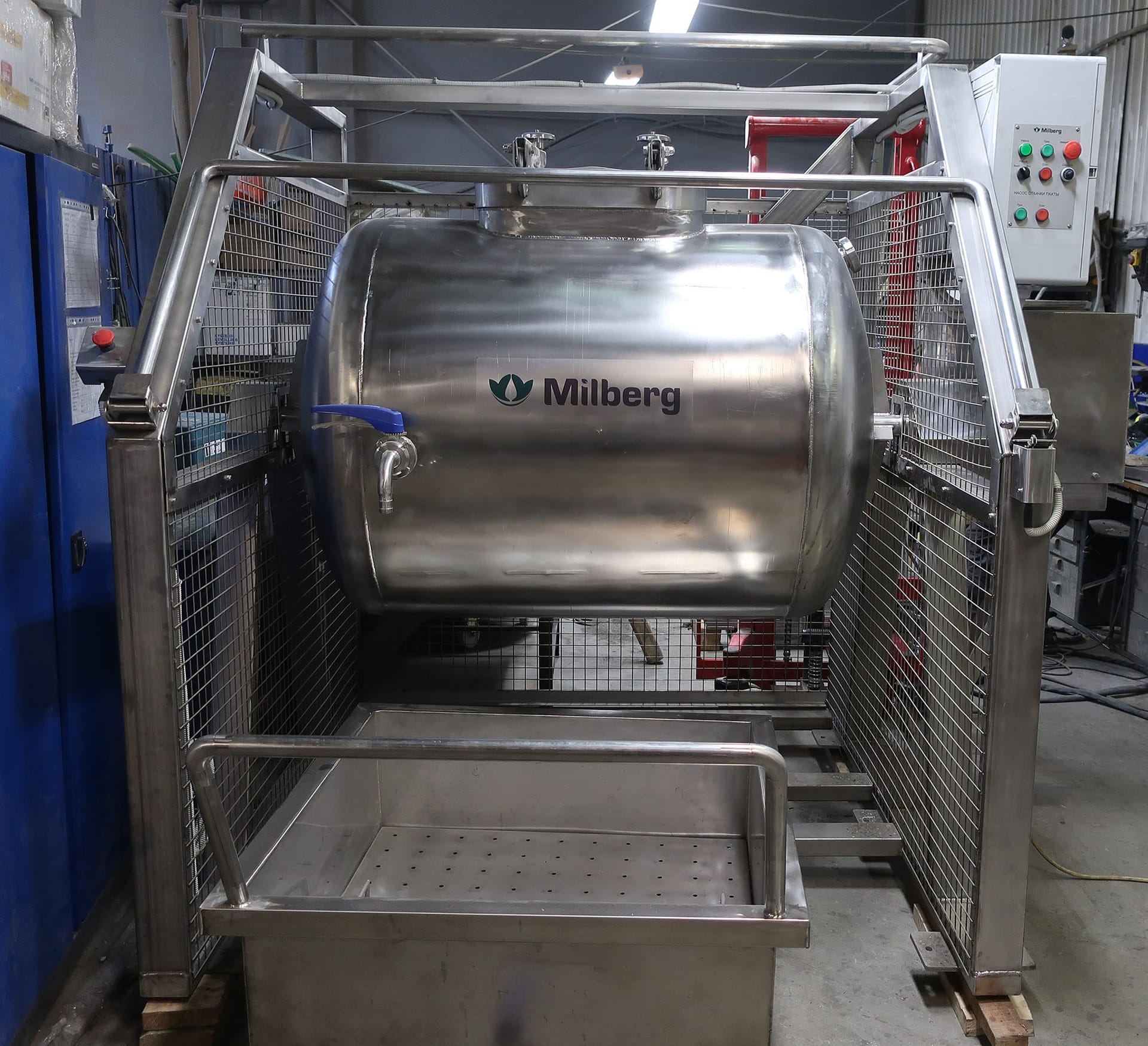
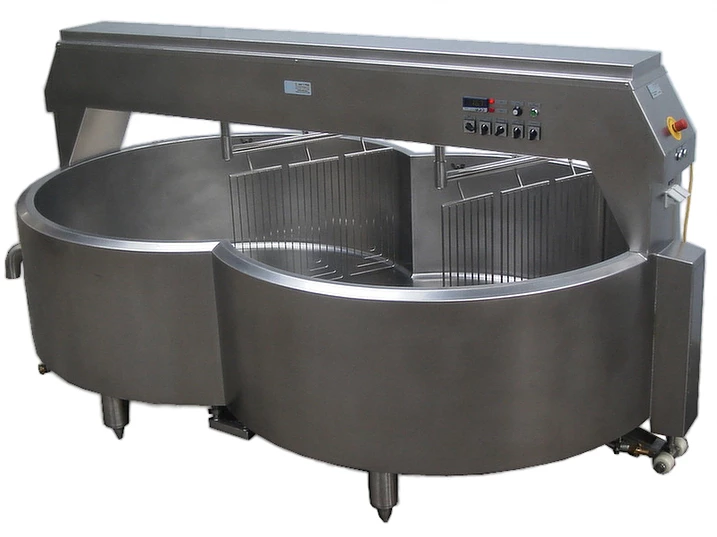
A VS cheese vat is a vessel made of food-grade AISI 304 stainless steel with a heating jacket and an agitator, in which milk is pasteurized and fermented and cheese curd grains are produced. Milberg makes cheese vats from 20 to 3,000 L: benchtop 220 V mini cheese vats for getting started and developing recipes, and industrial models for workshops and dairy plants. Product and jacket temperatures are maintained automatically by two sensors, and the curd is stirred manually, by an automatic curd harp or by a planetary agitator (VSP model).
Cheese vats and mini cheese vats from the manufacturer
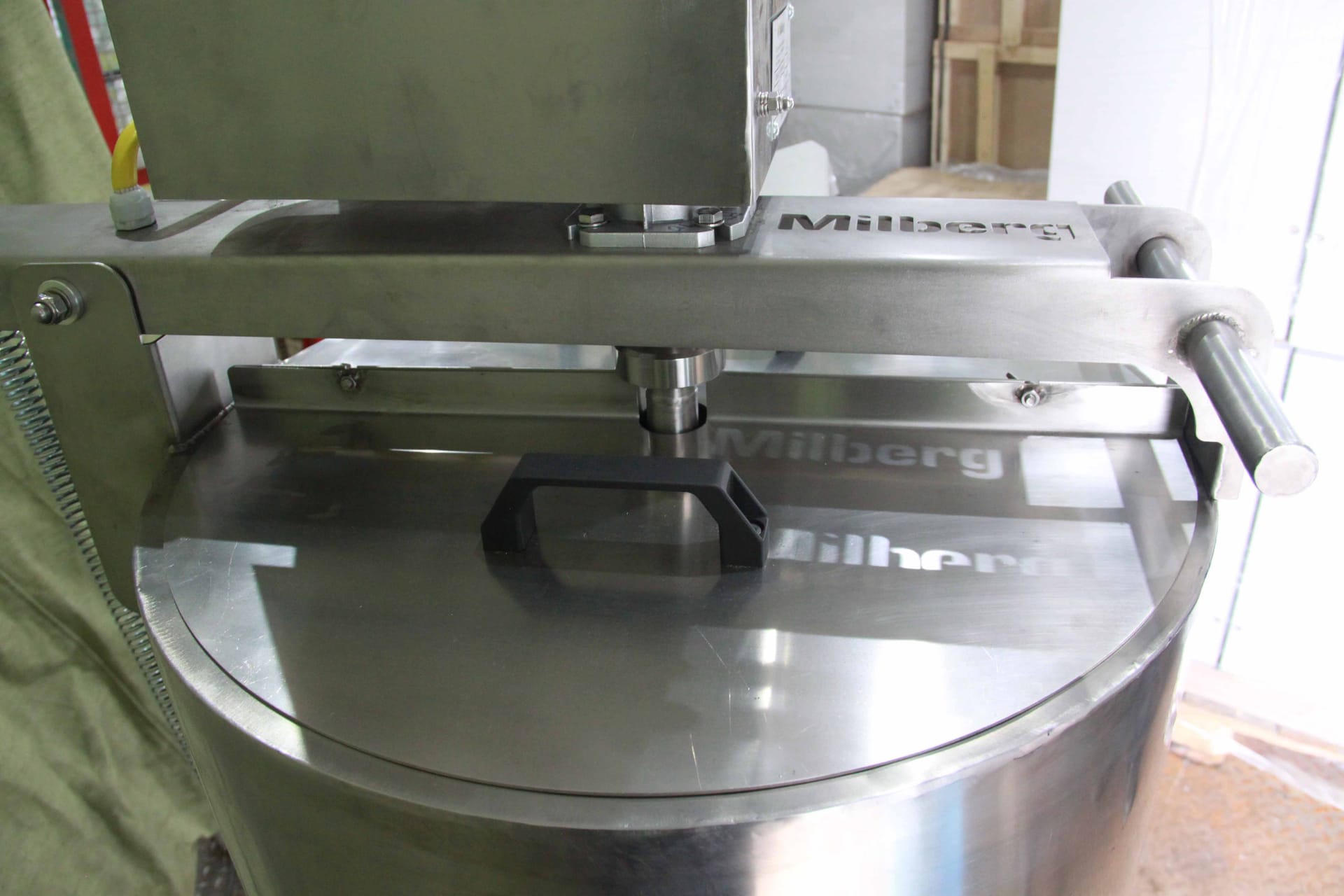
Milberg industrial cheese vats are designed for cheese making in small workshops and on family farms as well as at large dairy plants and processing complexes. Three main principles are built into the Milberg cheese vat: ease of operation and maintenance, reliability and affordability. The Milberg vat has a large diameter and low height, and the bottom is rounded with a smooth radius, which makes it comfortable to work with the curd grains and to clean the vat. For extra convenience the vat has a spring-loaded tilting drive: simply release the lock and swing the drive up (or slide it aside on large vats). The agitator also has a quick-release mounting. Reliability is based on solutions proven by many years of operation and on industrial-grade electronics, and spare parts are readily available. Affordability is key: we offer both simple versions for a successful business start and automatic cheese vats, direct from the manufacturer in Russia.
The simple version is operated from the control panel: automatic temperature control with the current product temperature shown on the panel, agitator on/off control, and manual cutting of the curd. Its key feature is dual-loop temperature control (with two temperature sensors), which maintains the temperature set on the panel accurately and stably — important in cheese making. Jacket and product temperatures are shown on the control panel. On request, the cheese vat can be equipped with several heating modes.
Milberg VS-A automatic cheese vats have a touch-screen control panel with recipe and programme selection, automated curd harp operation and cheese-making process, heating power control, and the option of connecting to the plant's process control network.
How cheese is made in an industrial cheese vat
The cheese-making process begins with filling the vat with raw milk and heating or pasteurizing it. Then starter culture is added and the curd develops. The curd is checked for a clean break with a finger, and acidity is checked in degrees Thorner. Next the coagulum is cut. This procedure can differ between recipes. Soft cheeses are easier to make, hard cheeses more difficult.
The cheese vat makes it possible to produce cheeses to various recipes. You can make traditional cheeses or cheeses with various additions — fenugreek, wild garlic, herbs — including signature varieties with sweet additions.
The cheese vat can be used to make soft cheeses such as Adyghe cheese, brynza and Ossetian cheese, as well as semi-hard and hard cheeses such as Rossiysky, Dutch, Parmesan, Yaroslavsky, Kostromskoy, Camembert and others, and, with the appropriate technology, mozzarella and ricotta (albumin curd).
Price from €1,900. The final cost depends on the configuration, technical specifications and the tasks the equipment is selected for: volume and capacity, heating type, level of automation and options. Write or call us — our process engineer will select a suitable option and prepare a quotation within one business day.
Advantages
- Model range from simple mini cheese vats for getting started to automatic vats with planetary agitator, curd harp knives and programme control
- Accurate automatic temperature control — consistent curd quality from batch to batch
- Gentle stirring and curd cutting with the harp without losing fat into the whey
- Suitable not only for cheese, but also for milk pasteurization and tvorog (quark) production
- Volumes from 50 to 3,000 L, made to your dimensions and requirements
Specifications
| Volume | 20–3000 L |
| Heating | steam / electric heating elements |
| Material | AISI 304/316 |
| Volumes we have supplied, L | 20 / 30 / 70 / 100 / 150 / 200 / 300 / 500 / 600 |
Included in equipment sets
Related articles
FAQ
What cheese vat volume should I choose to start with?
The volume is calculated from the amount of milk you process per batch. For getting started and developing recipes there are 30, 50 and 70 L mini cheese vats: they stand on a table and run on ordinary 220 V mains. Industrial models are made for 100–1,000 L, and up to 3,000 L to order. Our cheese-making process engineer will help you choose the volume for your cheese and milk quantity.
Which cheese vat volumes are ordered most often?
In our supplies, 150, 200 and 300-litre cheese vats are chosen most often: our website describes 8 projects with 150 L vats, 6 with 200 L vats and 7 with 300 L vats (VS, VSA, VSAP models), from Krasnodar Krai to Yakutia. For getting started and developing recipes there are 20–70 L mini cheese vats, for workshops 500–600 L, and for plants double-O cheese vats of 1,250–5,000 L.
Is there an automatic cheese vat?
Yes. In addition to the basic VS, we make VSA and VSAP automated cheese vats: they run pasteurization, fermentation and stirring according to the programme set by the dairy process engineer. Such vats are already in operation at our customers — for example, VSAP-150 and VSAP-300.
How much does a cheese vat cost?
The price is from €1,900. The final cost depends on volume, heating type, curd stirring method and options. Tell us how much milk you have and which cheeses you plan to make, and we will prepare a quotation within one working day.
Can the cheese vat be made with steam heating?
Yes. The standard version has electric heating elements for 220 V or 380 V depending on volume; to order, we make the vat for steam heating.
What is included in the scope of supply?
A food-grade stainless steel vessel, a geared motor, an agitator for milk and curd stirring, a DN50 or DN80 butterfly drain valve, a heating element unit (or a steam version), a wall-mounted control panel and the Milberg cheese maker's book with recipes and technology.
What else will I need for a cheese vat?
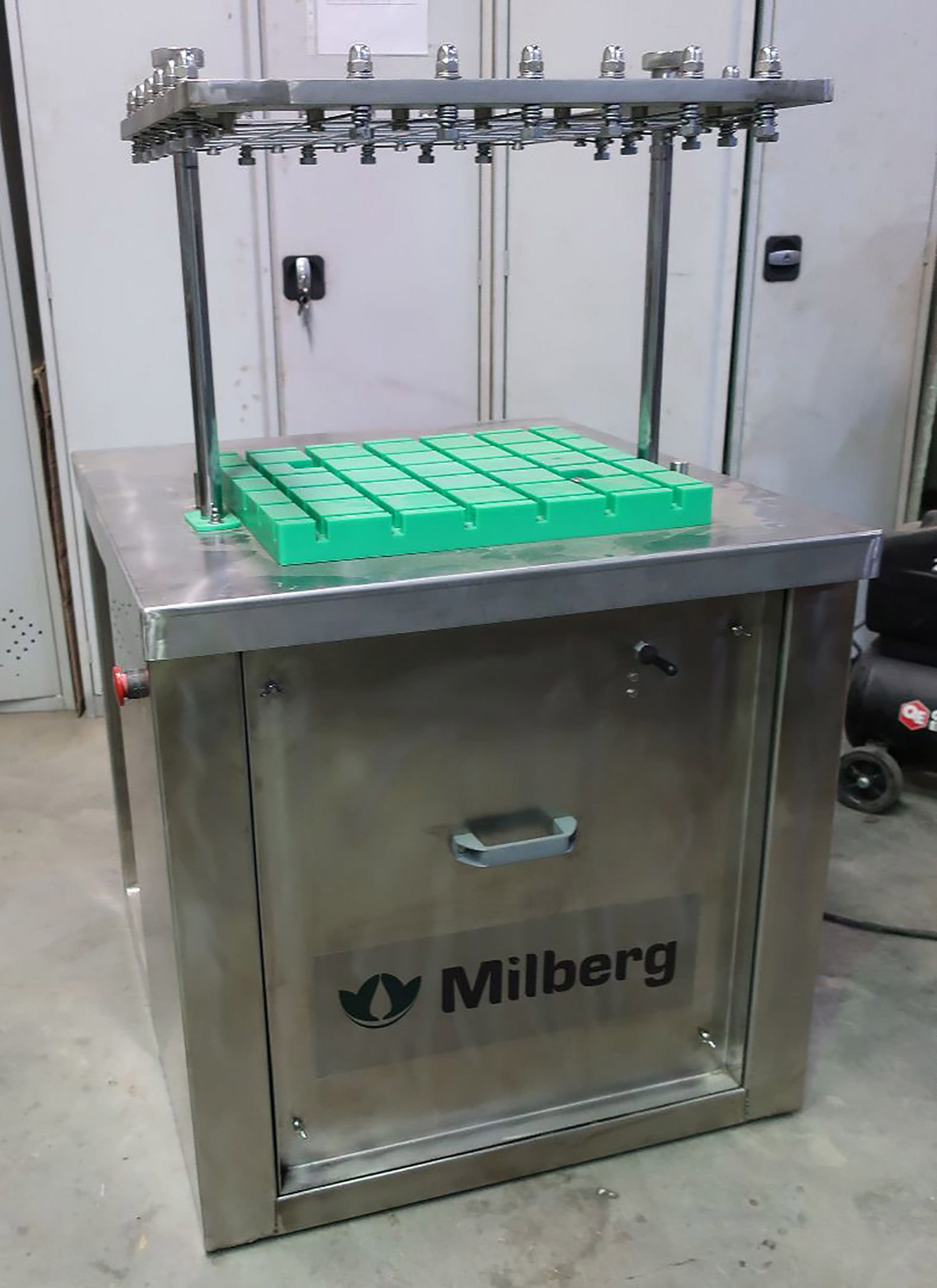
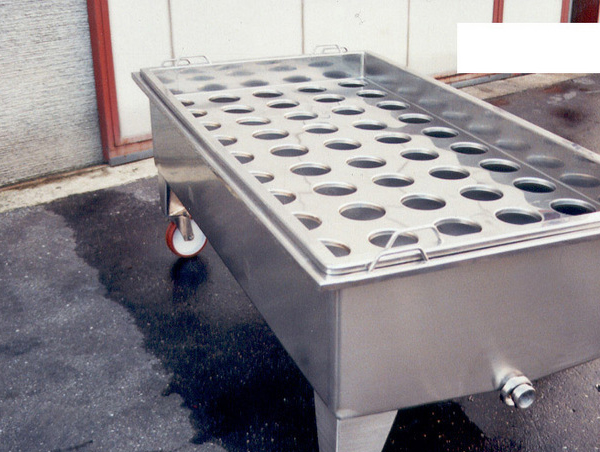
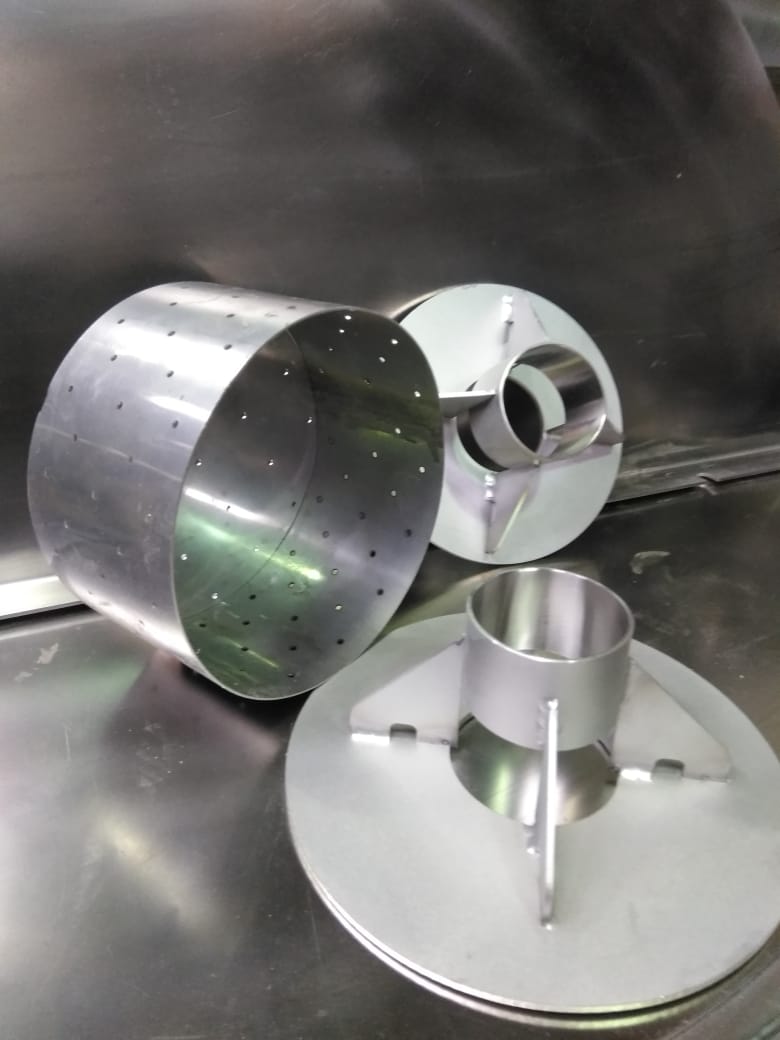
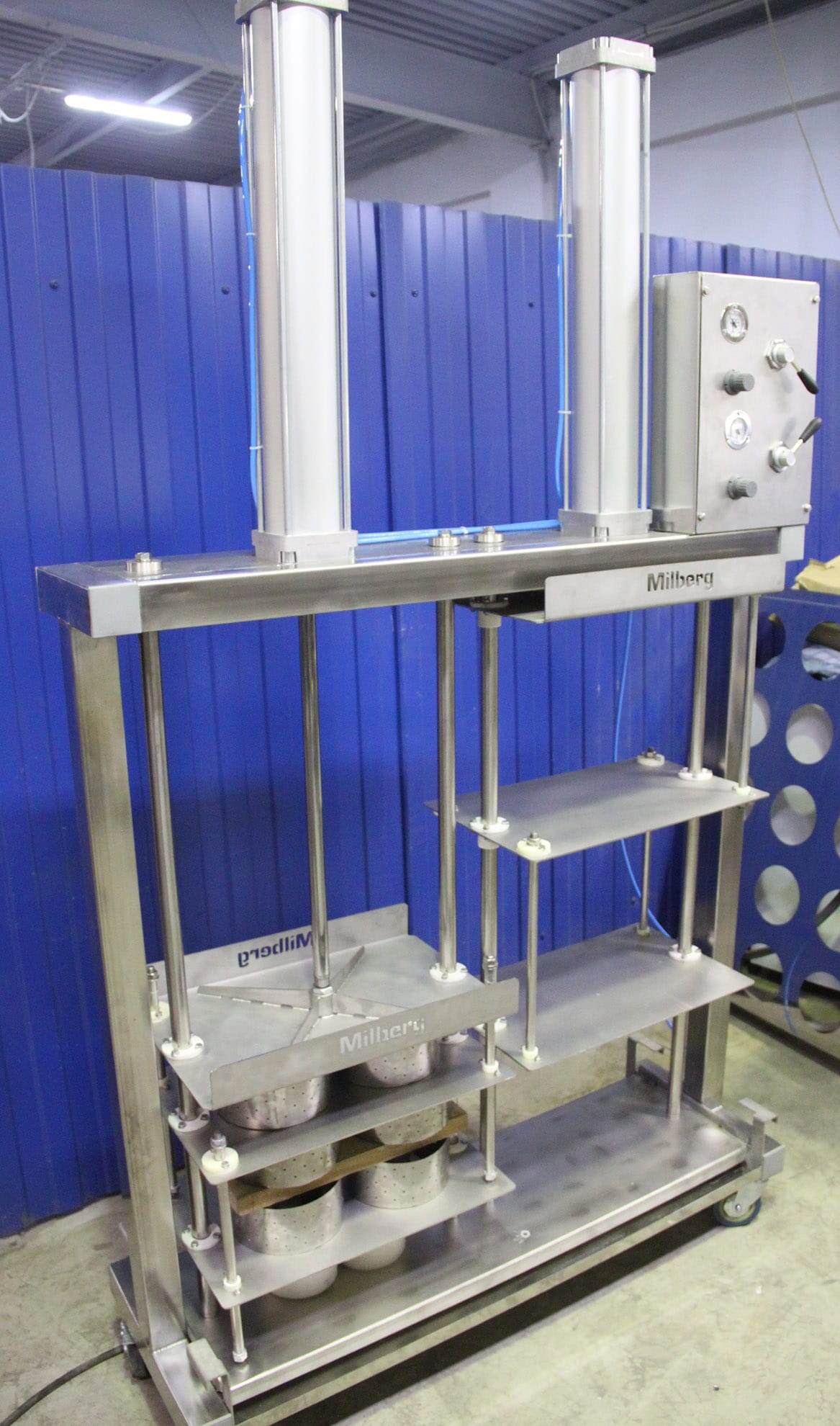
It depends on the cheese. Customers usually also buy moulds, a press (manual or pneumatic), a moulding or drainage table, a press trolley, additional curd harps, a drain filter, a false bottom and a pH meter. For plants with CIP cleaning we make a version for automatic cleaning.
Can milk be pasteurized and tvorog made in the cheese vat?
Yes. Product and jacket temperatures are set separately, so milk is pasteurized quickly, while viscous curd and cheese coagulum heats evenly without overheating. The cheese vat is used for cheese, pasteurized milk, tvorog and kefir.
Lead times, warranty and delivery?
If the required model is not in stock: up to 350 L — from 15 working days, over 350 L — from 20–25 working days after prepayment. Warranty is 12 months. We ship by freight carrier across Russia and the CIS and handle loading ourselves.
Where is this equipment already in operation?
Our website describes 31 projects with this equipment. Regions: Tver Region, Tomsk Region, Tula Region, Yamalo-Nenets Autonomous Okrug, Krasnodar Krai, Ulyanovsk Region, Orenburg Region, Stavropol Krai and others. Customers: family farm, manufacturing company, private producer. See the "Projects with this equipment" block and the Projects section.