


Cheese production business plan, or equipment payback

Today, with sanctions and counter-sanctions in force, and with the US "trade war against everyone" now under way, cheesemaking has become an integral part of Russia's import substitution policy. In Russia cheese is produced by large plants, by small cheese dairies and by artisan makers. The market is still in deficit, but it is filling up fast.
If you are planning your own cheese dairy, buying an established business is expensive right now because the industry is on the rise. However, you can invest in expanding an existing operation and thus buy a stake. The development of cheesemaking is already being held back by the slow growth of the raw milk base — a traditional problem of the processing industry. The whole chain is gradually taking shape: from expanding the feed base and herd size to growing milk volumes, which in turn affects the scale of cheesemaking.
Prospects for cheese production
Only large plants can afford licensed production, while private entrepreneurs are actively opening mini cheese dairies that produce to order for nearby customers. Experience shows that the payback of a cheese dairy depends heavily on the starting conditions. Predictably, the main asset will be the premises for cheese production. If suitable premises are already available, the lion's share of the costs goes on buying and installing the equipment.
A typical business plan for opening a mini cheese dairy in a town includes the following cost items:
- purchasing all the equipment as a complete set from one manufacturer;
- fitting out a small workshop with a shop attached;
- refurbishing your own premises for production rather than building or renting.
Focusing on artisan production from the outset implies an original recipe — your own or a traditional one. There are few competitors in this unique format at present, the cost of opening a mini cheese dairy is low (it can be done for about €11,200), and as the customer base grows, expanding output and the product range is very likely.
As for cheese types, the situation has now stabilized: soft and semi-hard cheeses are produced in large volumes, hard cheeses are catching up fast, and only fine premium cheeses are still in short supply. It is precisely the premium segment that is a clear priority for mini cheese dairies. You can buy either an industrial cheese vat or a mini cheese vat of less than 100 L; in either case, the choice should be based on the volume of raw milk and your growth plans.
Milberg equipment mentioned in this article
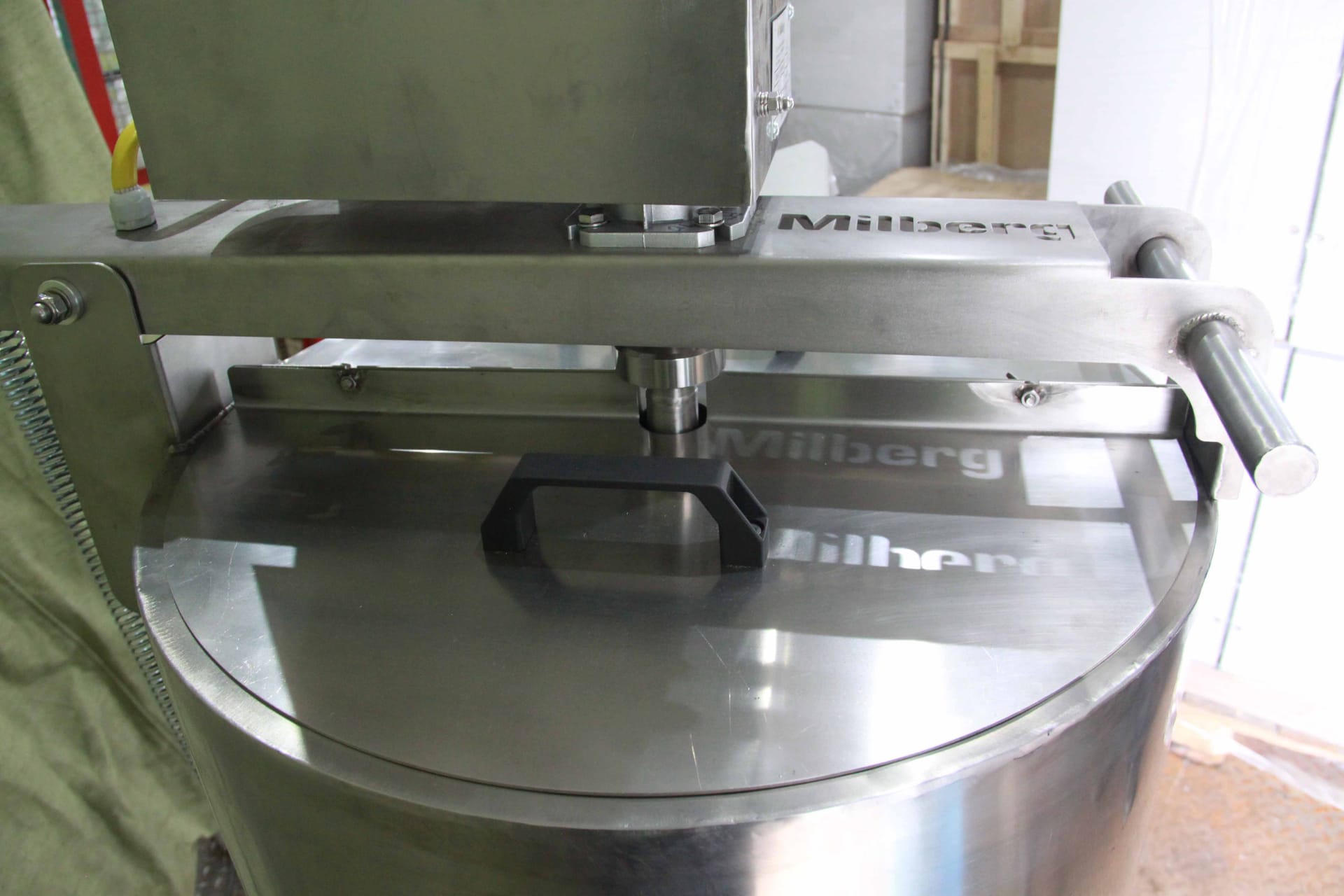 VS cheese vatHard and soft cheeses. From 20 to 3,000 L
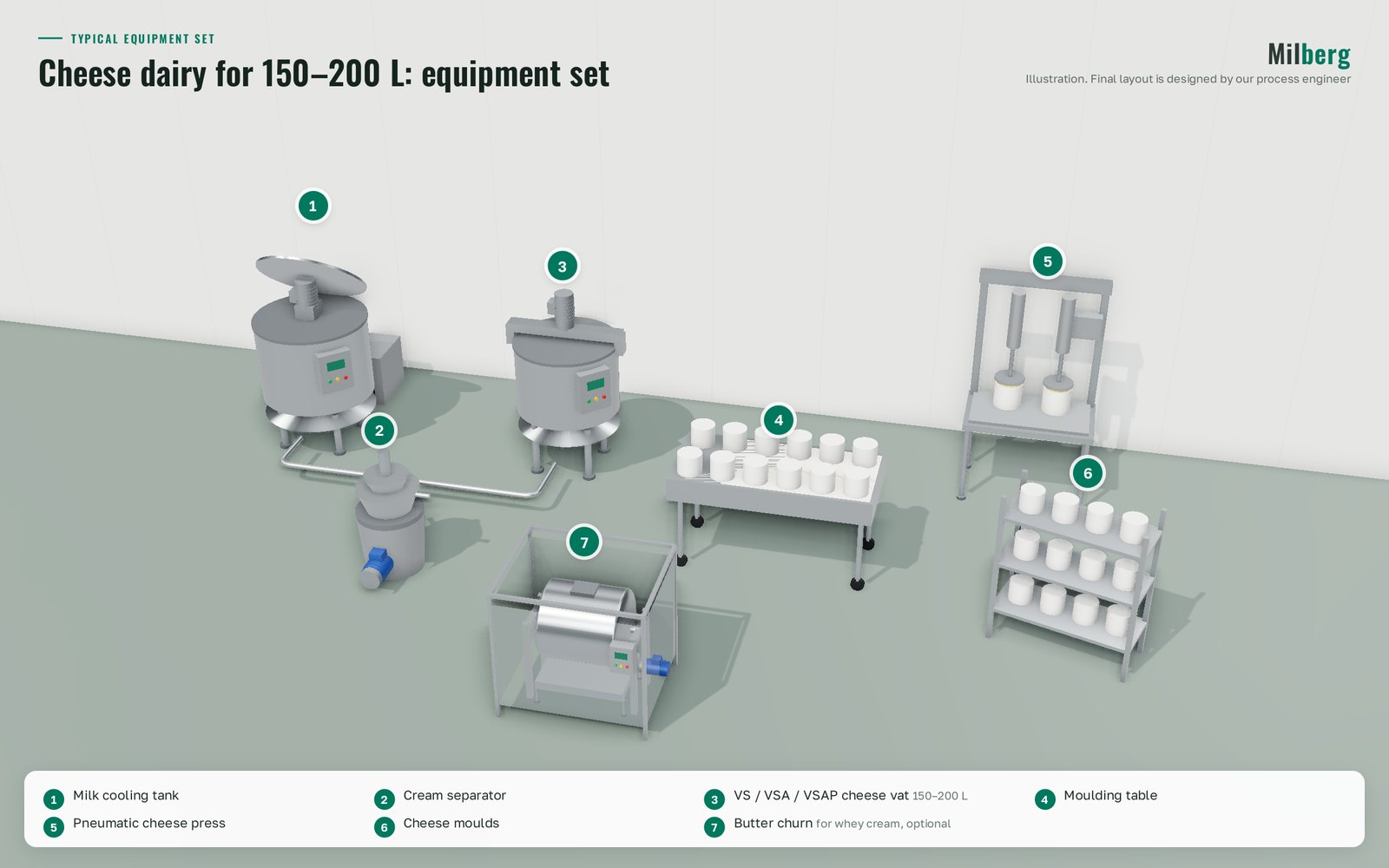 150–200 L cheese dairy: equipment set for farms and artisan cheese makersThe most common volume in our supplies: cheese vat, press, moulds, separator
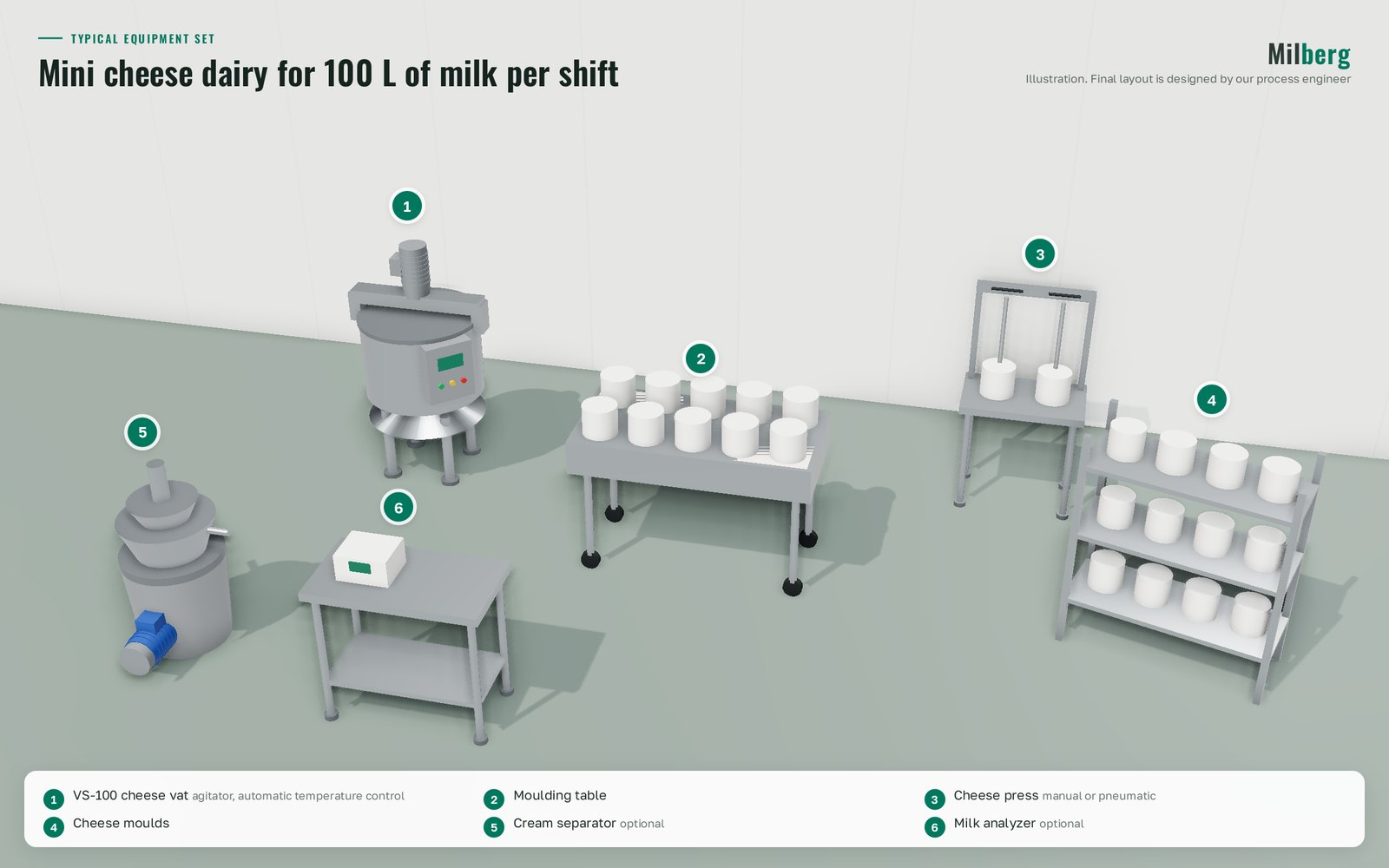 Mini cheese dairy equipment for 100 L of milkStarter set — cheese vat, press, moulds, moulding table
Catalogue sections: Cheese making equipment, Milk processing equipment, Equipment sets, modular dairies and mini plants