


How to start a cheese dairy: equipment for 100, 300 and 1,000 litres of milk
In brief. The equipment for a cheese dairy depends on two things: how much milk you process per shift and which cheeses you make. For soft cheeses at 100 L, a cheese vat, moulds and a moulding table are enough. For semi-hard and hard cheeses, a press is added. From 500 L, milk is pasteurized in a separate vat and transferred by pumps, and from 1,000 L a continuous line is built. Most of our customers start with a cheese vat of 150–300 L. Milberg equipment sets cost from €5,600 for a 100 L mini cheese dairy and from €11,200 for larger workshops.
Where to start: milk volume and cheese types
Before choosing equipment, answer two questions.
- How much milk per shift. Your own milk or purchased milk, how much there will be now and in a year's time. The volume determines the size of the cheese vat and everything else: the press, the number of moulds, whether you need separate pasteurization.
- Which cheeses. For soft cheeses the equipment set is minimal. The process for semi-hard and hard cheeses is more complex: you will need pressing, salting and ripening. For pasta filata cheeses — chechil, suluguni, mozzarella — you also need a cheese melter and a cheese string forming unit.
The basis of any set is the cheese vat. In it, milk is pasteurized and coagulated and the cheese curd is made; product and jacket temperatures are held automatically by two sensors. Milberg makes cheese vats from 20 to 3,000 L, and for dairy plants, double-O cheese vats of 1,250–5,000 L.
Equipment by volume: summary table
| Milk per shift | Core equipment | What else is included | Equipment set |
|---|---|---|---|
| 100 L | VS-100 cheese vat | Moulds, moulding table, press for semi-hard and hard cheeses; cream separator if needed | Mini cheese dairy for 100 L, from €5,600 |
| 150–200 L | VS, VSA or VSAP cheese vat | Pneumatic press, moulds, 1–2 moulding tables, cream separator; VDP optional | Cheese dairy for 150–200 L, from €11,200 |
| 300 L | VS-300 or VSAP-300 cheese vat | Milk cooling tank for reception, VDP, cream separator, pneumatic press, moulds, tables | Cheese workshop for 300 L, from €11,200 |
| 500–600 L | VS-500 or VS-600 cheese vat | Milk cooling tank, milk pump, VDP-500/630, cream separator from 500 L/h, 1–2 presses | Cheese workshop for 500–600 L, from €11,200 |
| 1,000–1,250 L | 1,250 L double-O cheese vat or two 500–600 L cheese vats | Reception station, tanks, tubular pasteurizer or VDP-1000, pumps, presses | Cheese production line for 1,000 L, from €11,200 |
| 2,000–5,000 L | Double-O cheese vats of 2,500–5,000 L | Reception, buffer storage, continuous pasteurization, automation | Cheese plant for 2,000–5,000 L, from €11,200 |
The table shows typical configurations: our dairy process engineer refines them for your product, volume and premises.
Mini cheese dairy for 100 litres
The simplest way to start making cheese on a farm, in a craft workshop or in an urban cheese dairy. A VS-100 cheese vat made of AISI 304 stainless steel, moulds and a moulding table are enough for soft cheeses. For semi-hard and hard cheeses you need a cheese press: manual or pneumatic, the latter holding a force of up to 150 kg without an operator. We make moulds from stainless steel and food-grade plastic to suit the cheese weight, from a single piece.
If you first need to work out your recipes, compact cheese vats of 20–70 L are available. When your volume grows, the 100 L vat is kept for trial batches, while the press, moulds and tables move to the new workshop.
150–300 litres: the most common starting point
Judging by our deliveries, this is the most popular size: the website describes 8 projects with 150 L cheese vats, 6 with 200 L and 7 with 300 L. Our 300 L cheese vats are working everywhere from Krasnodar Krai and Stavropol Krai to Sakha (Yakutia) Republic.
At this volume, milk is already received and cooled in a milk cooling tank, pasteurized in a long-time pasteurization vat or directly in the cheese vat, and standardized with a cream separator. This is followed by moulding on the table, pressing in a pneumatic press, salting and ripening.
If the number of batches grows, instead of the basic VS cheese vat customers choose the automated VSA or VSAP: it runs pasteurization, coagulation and stirring according to the programme set by the dairy process engineer.
500–1,000 litres: moving to a line
At 500–600 L, milk is transferred by milk pumps, pasteurized in a separate vat while the cheese vat is busy with a batch, and several cheeses are pressed at once. This is how our customers grow: a private cheese dairy in Sverdlovsk Region moved up to a VS-500 when small volumes no longer allowed enough batches per shift.
From 1,000 L, cheese is made on a continuous basis: the equipment is connected by pipework, milk is received at a reception station and pasteurized in a tubular pasteurizer or a VDP-1000, and the process can be controlled from an automation cabinet. The cheesemaking section is built around a double-O cheese vat or two cheese vats — the second gives flexibility if you make different recipes.
What is added later
- A butter churn. The cream left over from standardizing the milk is churned into butter. Several of our customers have done this — for example, a cheese dairy in Krasnodar Krai bought a VS-300 cheese vat together with a butter churn.
- A second cheese vat — when demand grows or you need to make different cheeses in parallel.
- A cheese melter and UFSN cheese string forming unit — if you decide to make pasta filata cheeses: chechil, suluguni, mozzarella.
Equipment for your own premises or a modular cheese dairy
There are two options. The first is an equipment set for your own premises, selected to suit the floor area, available utilities and sanitary requirements. The second is a turnkey modular cheese dairy: a sandwich-panel building with the equipment already installed and connected, plus utilities and ventilation. It is delivered, placed on a foundation and connected.
How much does cheese dairy equipment cost?
Milberg equipment sets cost from €5,600 for a 100 L mini cheese dairy and from €11,200 for workshops from 150 L. Guide prices for individual items are on their pages: cheese vat from €1,900, press from €400, moulding table from €500, moulds from €10. The final cost depends on the volume, the cheeses and the degree of automation. Our dairy process engineer will select the equipment for your product, and we will prepare a quotation within one working day.
All equipment sets are in the section "Equipment sets, modular workshops and mini plants". For more on the technology, see the articles "Hard cheese production technology", "Cheese salting" and "Cheese press: manual, screw or pneumatic".
Milberg equipment mentioned in this article
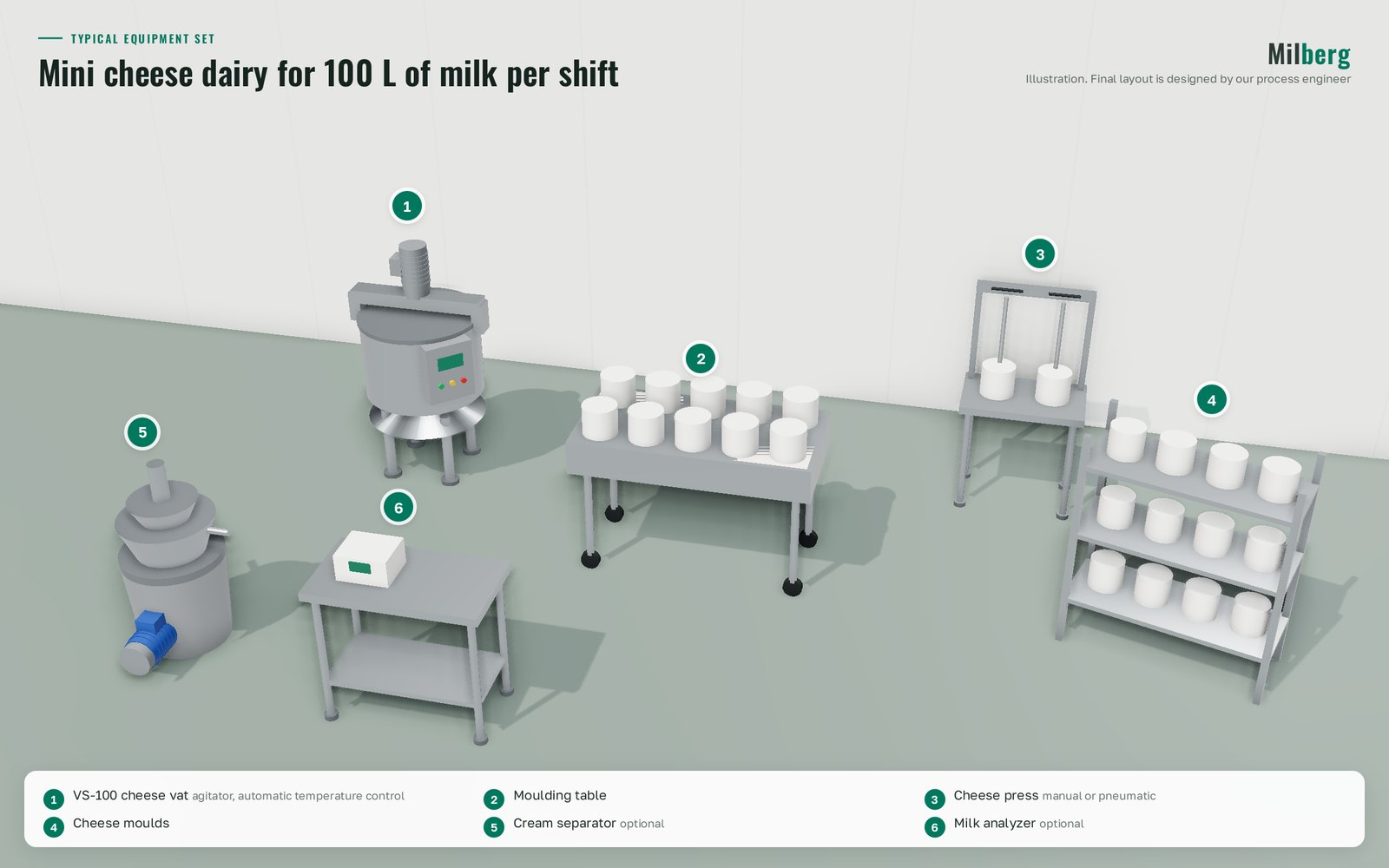 Mini cheese dairy equipment for 100 L of milkStarter set — cheese vat, press, moulds, moulding table
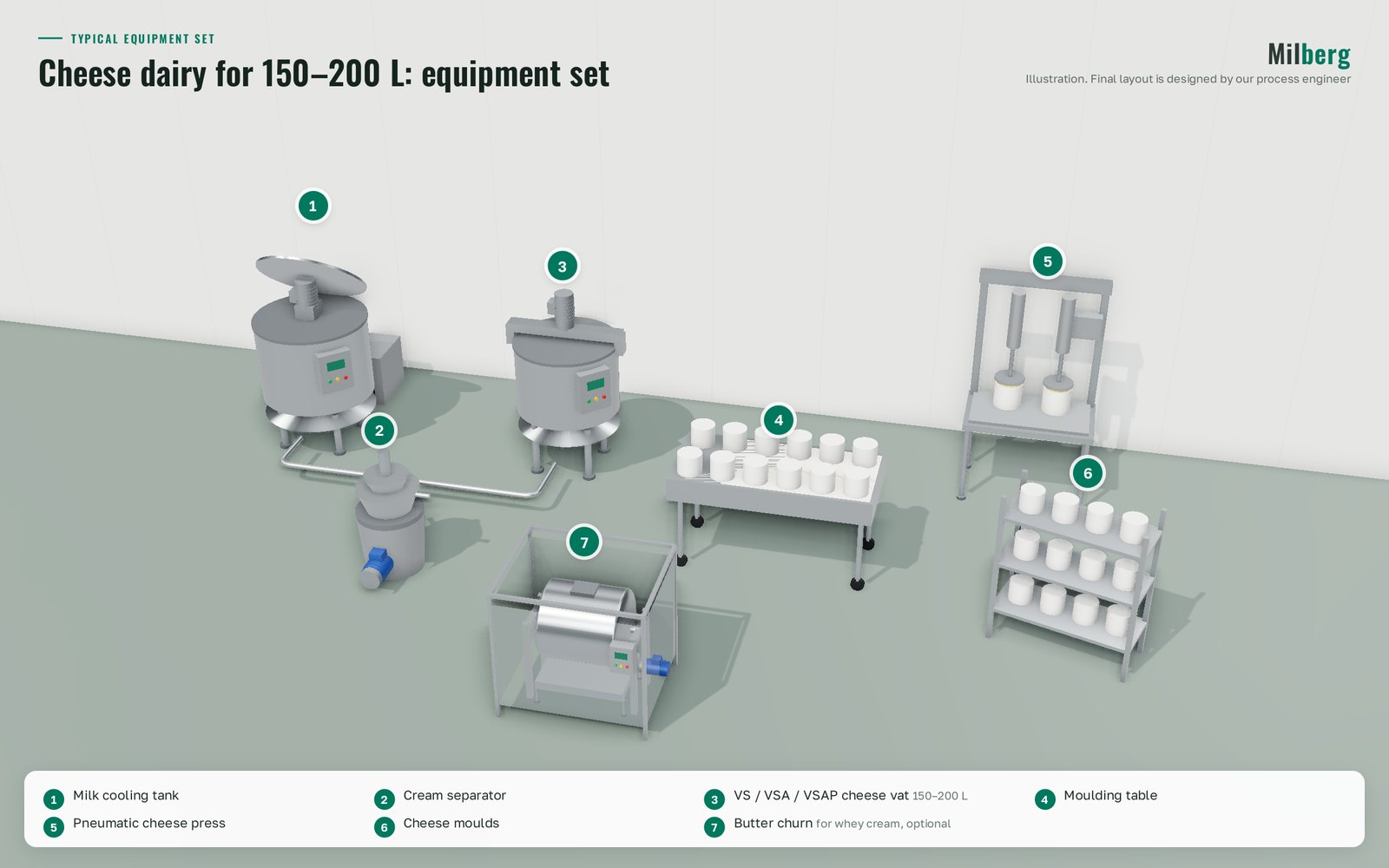 150–200 L cheese dairy: equipment set for farms and artisan cheese makersThe most common volume in our supplies: cheese vat, press, moulds, separator
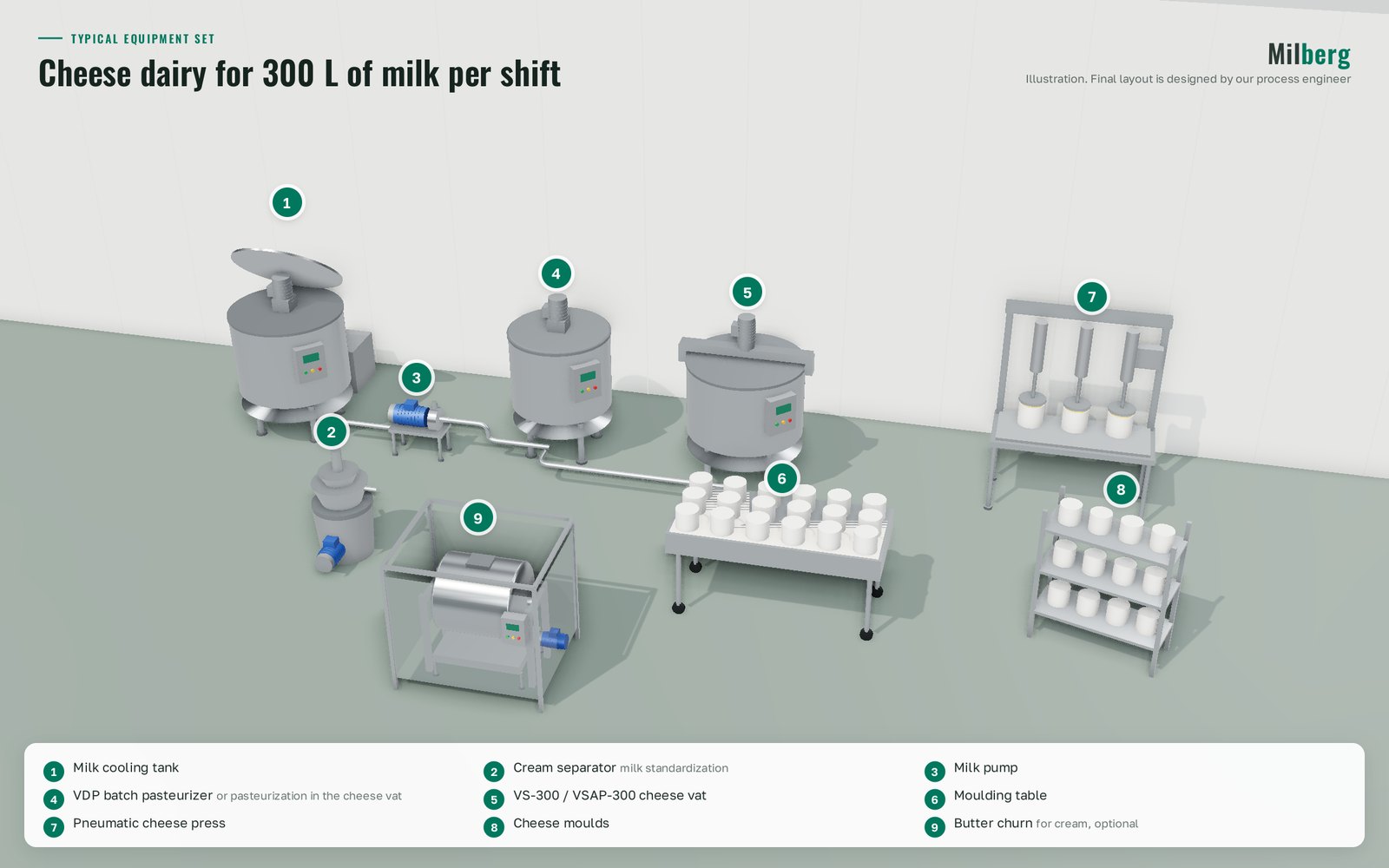 Cheese workshop for 300 L of milk: equipment set300 L cheese vat, press, moulds, pasteurization, milk cooling
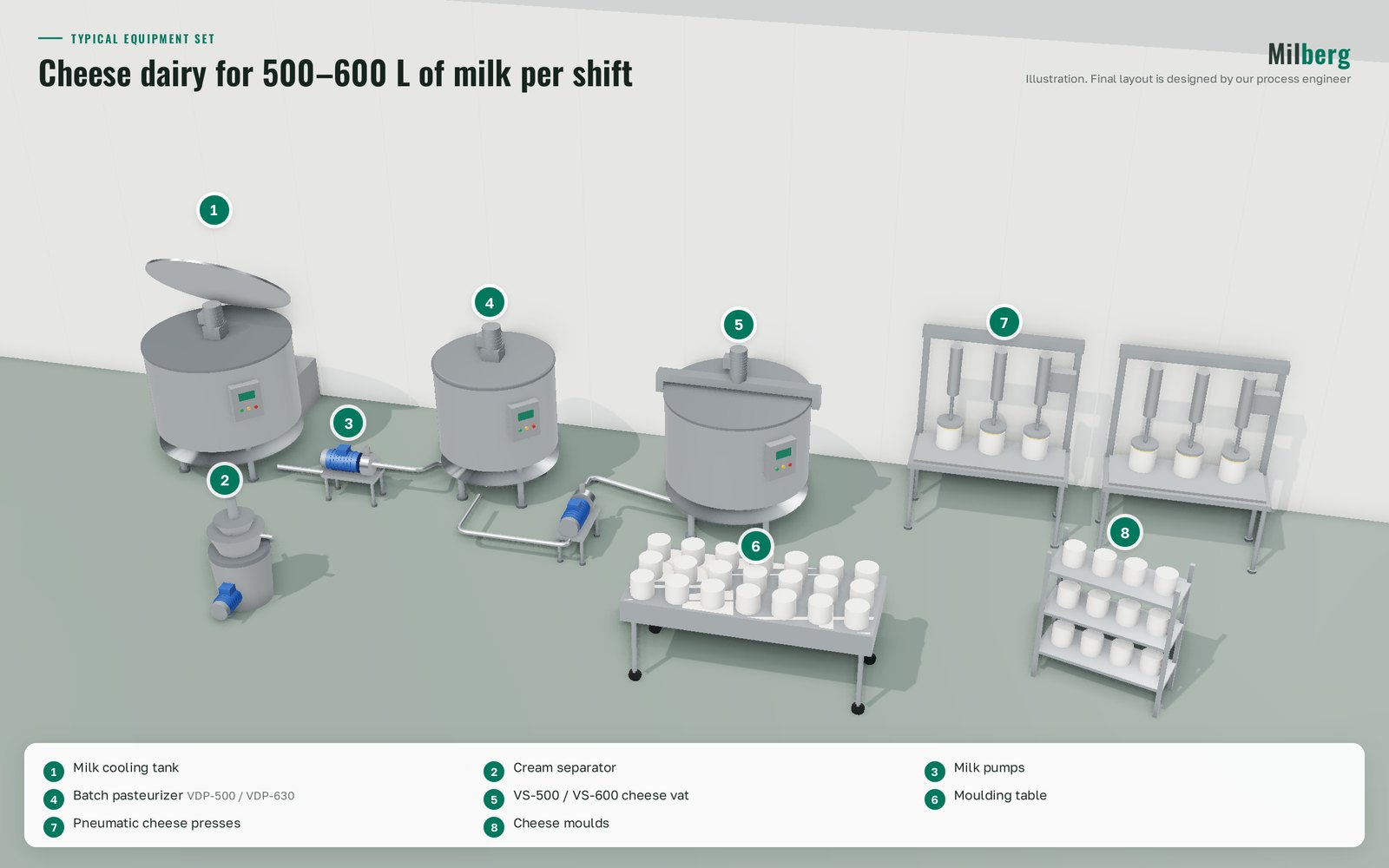 Cheese workshop for 500–600 L of milk500–600 L cheese vat, pasteurization, pumps, pressing
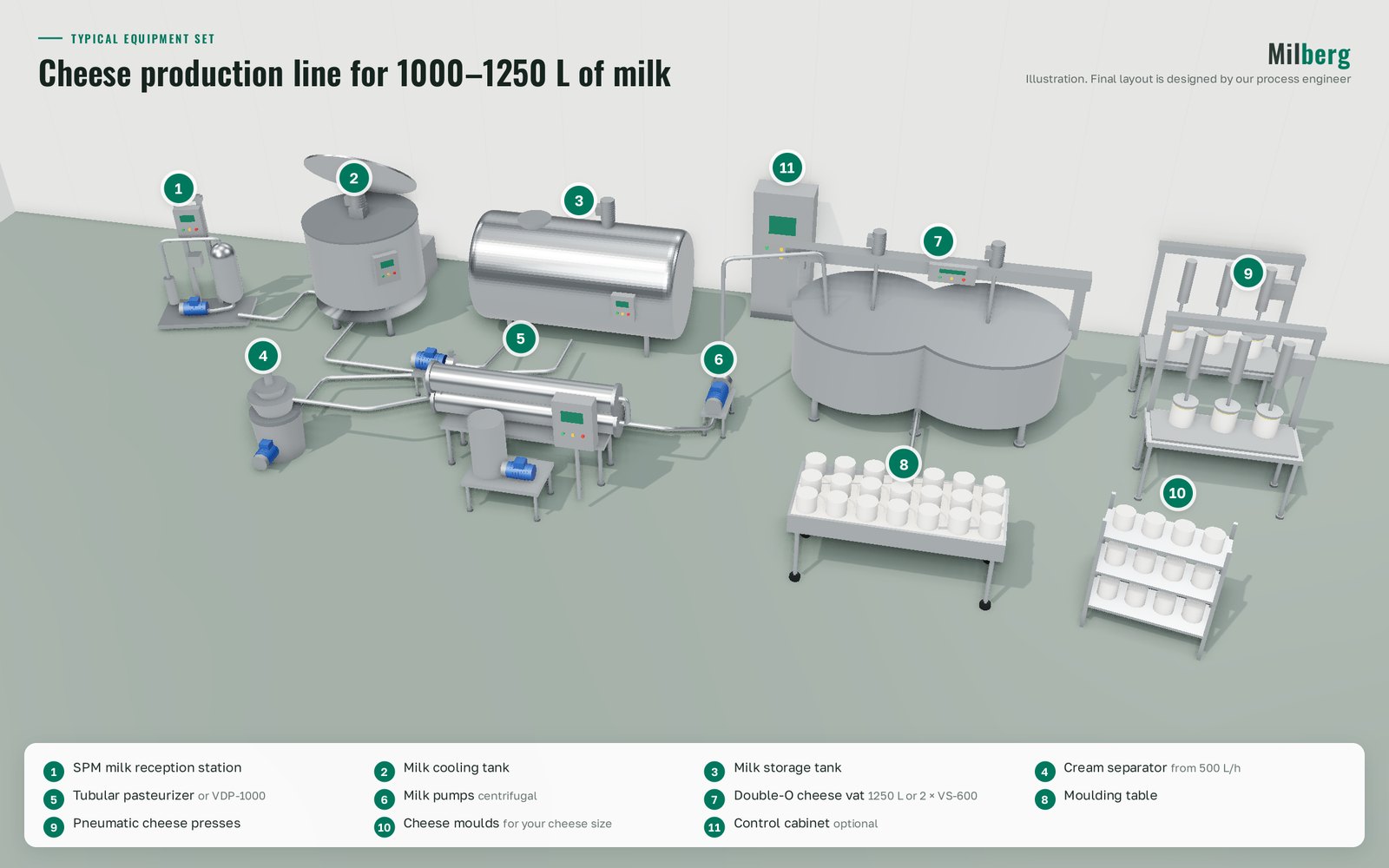 Cheese production line for 1,000–1,250 L of milkContinuous line — reception, pasteurization, cheese vats, pressing
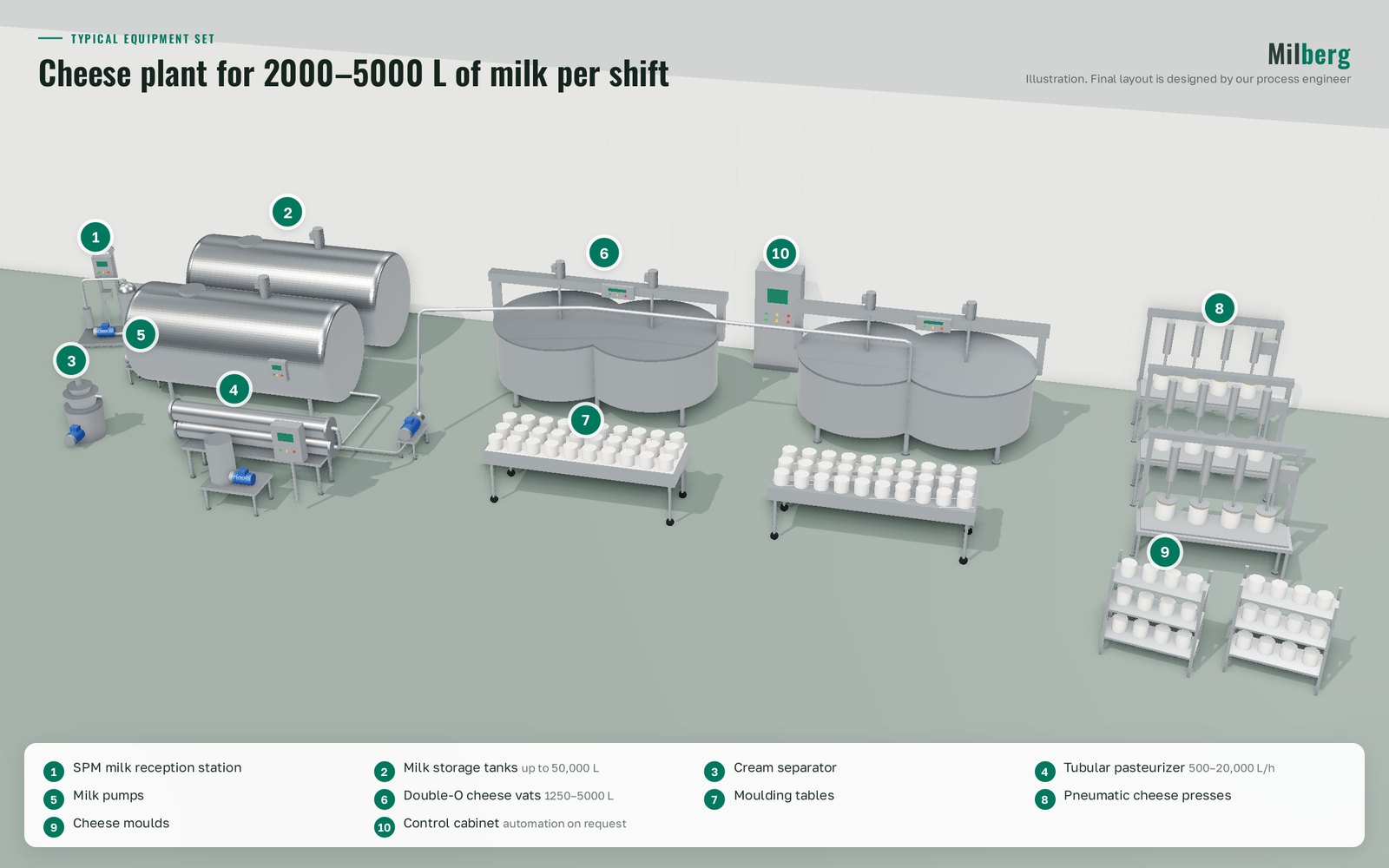 Cheese plant for 2,000–5,000 L of milk: equipmentIndustrial cheese vats, continuous pasteurization, milk reception, automation
Catalogue section: Equipment sets, modular dairies and mini plants