


Cream separator: how to choose one for a farm or dairy workshop
In brief. A cream separator uses centrifugal force to split whole milk into cream and skim milk, and makes it possible to standardize the milk fat content to the recipe for cheese, tvorog (quark), butter or drinking milk. Farms and small workshops are usually well served by an open-type separator — it is more affordable and does not need closed pipework with CIP cleaning; the closed type is installed in lines with piping. Capacity is matched to the processing volume: separators of 500 L/h and above are the most common choice.
What a cream separator does
Inside the separator, a bowl with a stack of discs rotates at high speed. Milk enters the bowl, and centrifugal force divides it into two fractions: the heavier skim milk is thrown towards the walls, while the lighter fat collects closer to the axis and leaves separately as cream. The result is two streams: cream and skim milk.
The fat content of the cream is set by adjusting the separator. By mixing cream and skim milk in the right proportion, you get milk of the required fat content — this is standardization. More on this in the article "What standardization is and why it is needed".
Milk is usually separated warm: when heated, the fat separates more completely and the skim milk comes out leaner.
Open or closed separator: which to choose
This is the first question to settle, because it determines what other equipment you will need.
In an open separator, milk is fed from a receiving bowl on top, and the cream and skim milk exit through open spouts into containers placed underneath. It works on its own, without pipework, and is dismantled by hand for cleaning.
A closed (hermetic) separator is built into a line: milk is fed by a pump, and the cream and skim milk flow through pipes onward — to a cream ripening vat, a pasteurizer or a tank. Such a system is cleaned without dismantling, by CIP.
"Farms and small producers are generally best served by open-type separators: they are the most affordable, and they do not need a closed pipework system that has to be flushed by CIP cleaning." — Alexey Troshin, Director of the Milberg plant
| Parameter | Open separator | Closed separator |
|---|---|---|
| How milk is fed | From a receiving bowl on top | By pump through a pipeline |
| Where cream and skim milk go | Through spouts into containers | Through pipes to the next piece of equipment |
| Cleaning | Bowl dismantled by hand | CIP cleaning without dismantling |
| Pipework required | No | Yes |
| Suitable for | Farms, cheese dairies, small workshops | Dairy workshops and plants with continuous lines |
What capacity you need
Separator capacity is stated in litres of milk per hour. It is calculated from how much milk has to be processed per shift and in what time. For example, 1,000 L passes through a 500 L/h separator in about two hours of net running time.
In our plant's experience, separators of 500 L/h and above are ordered most often. Smaller models are available for small sets: the turnkey modular cheese dairy includes an 80 L/h separator.
How an industrial separator differs from a household one
This is a frequent question in enquiries: customers say outright that they need "not a household unit but a solid professional" separator. A household separator is designed for domestic volumes and short running times. An industrial separator for a workshop is selected for the processing volume; its product-contact parts are made of food-grade AISI 304 stainless steel, and the bowl can be dismantled so that it can be cleaned thoroughly after each shift.
The second frequent question is lead time. If you need a separator urgently — for example, to replace one that has broken down — say so in your enquiry right away: we will find an option that fits both the capacity and the delivery time.
What equipment a separator is installed with
A separator rarely works on its own — it is usually one link in the milk processing chain:
- Cheese dairy. A separator is needed if milk is standardized for fat to the cheese recipe, or if butter is made from whey cream. It is included in the sets for a 100 L mini cheese dairy and cheese workshops of 300–600 L.
- Butter workshop. The separator removes the cream, which is adjusted for fat, pasteurized and cooled in the VN cream ripening vat; the batch butter churn then churns cream of 25–40% fat into butter. The full set is on the page "Butter workshop for 50–300 L of cream".
- Farm. The basic set for on-farm milk processing is a milk cooling tank, a VDP batch pasteurizer and a cream separator. The skim milk is not wasted: it is used to feed calves.
Do not confuse a cream separator with a separator for high-fat cream: the latter is installed in continuous butter lines and splits ready cream into high-fat cream and buttermilk. For a farm, cheese dairy or small butter workshop, a cream separator is what you need.
How the separator is tested before shipment
"Before shipment we test separators on water: tightness, vibration and noise levels." — Alexey Troshin, Director of the Milberg plant
Every separator is run on water before it is sent to the customer — so that a leak or excessive vibration is detected at the factory rather than after installation in the workshop.
Where this equipment is already in operation
In January 2023, a manufacturing company in the Moscow Region launched its own cheese section: the delivery included a VS-150 cheese vat and a cream separator. The separator splits the milk into cream and skim milk, the mix is standardized for fat to the cheese recipe, and surplus cream goes into sour cream or butter — the milk is used in full. All projects are in the ["Case studies"](/projects/ section.
Tell us how much milk you process per shift and what you produce — we will select a cream separator of the right capacity and type and send a quotation within one business day. All equipment for this stage is in the "Milk processing equipment" section.
Milberg equipment mentioned in this article
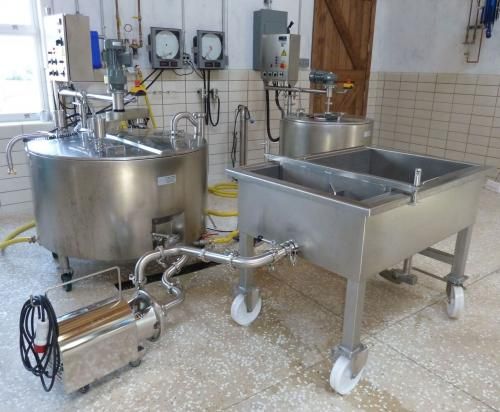 Modular cheese dairy (turnkey set)Cheese production line from 100 L per shift
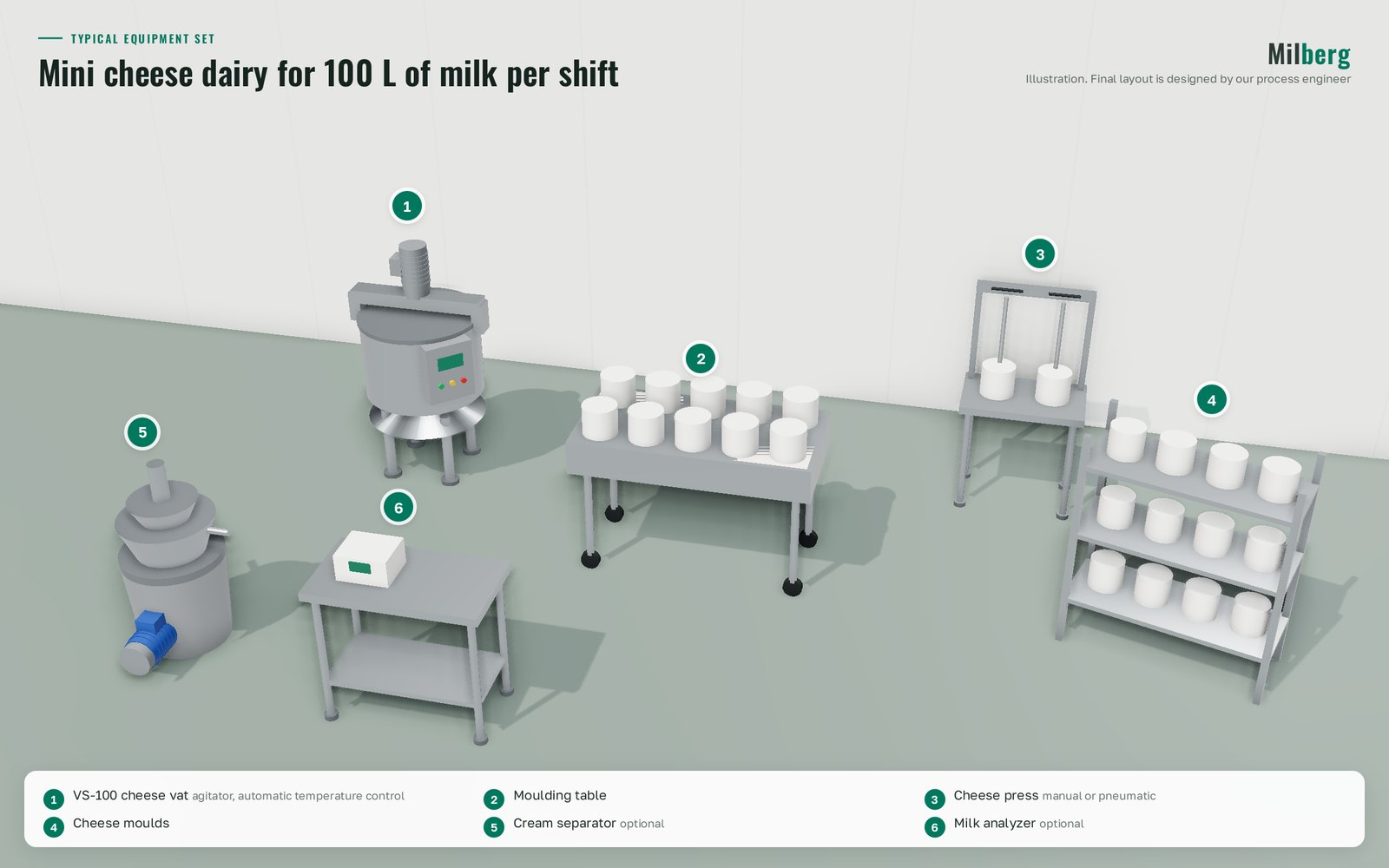 Mini cheese dairy equipment for 100 L of milkStarter set — cheese vat, press, moulds, moulding table
 VN cream ripening vatStandardization, pasteurization and cooling of cream
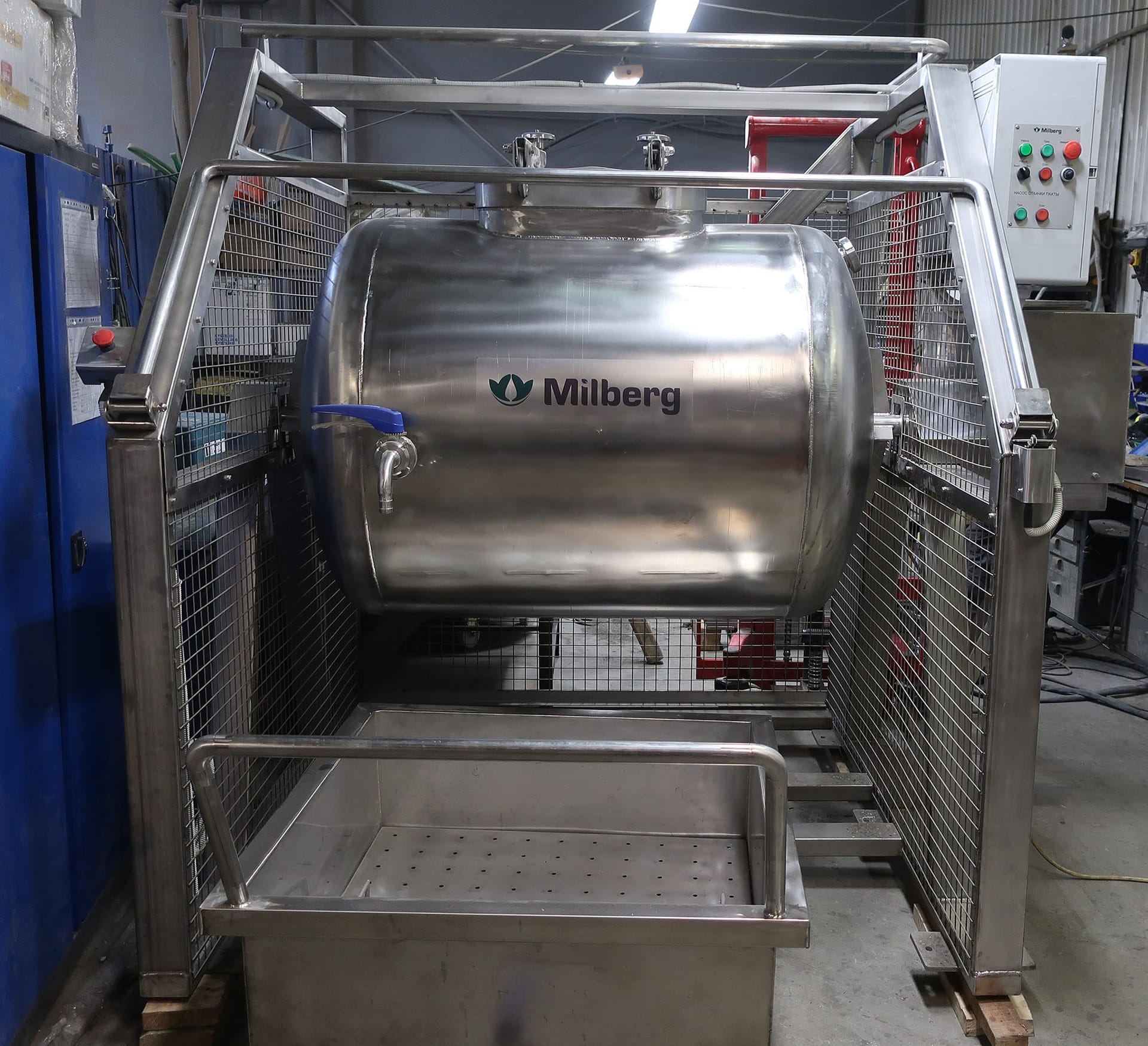 Batch butter churn (industrial butter churn)Butter production by the traditional churning method
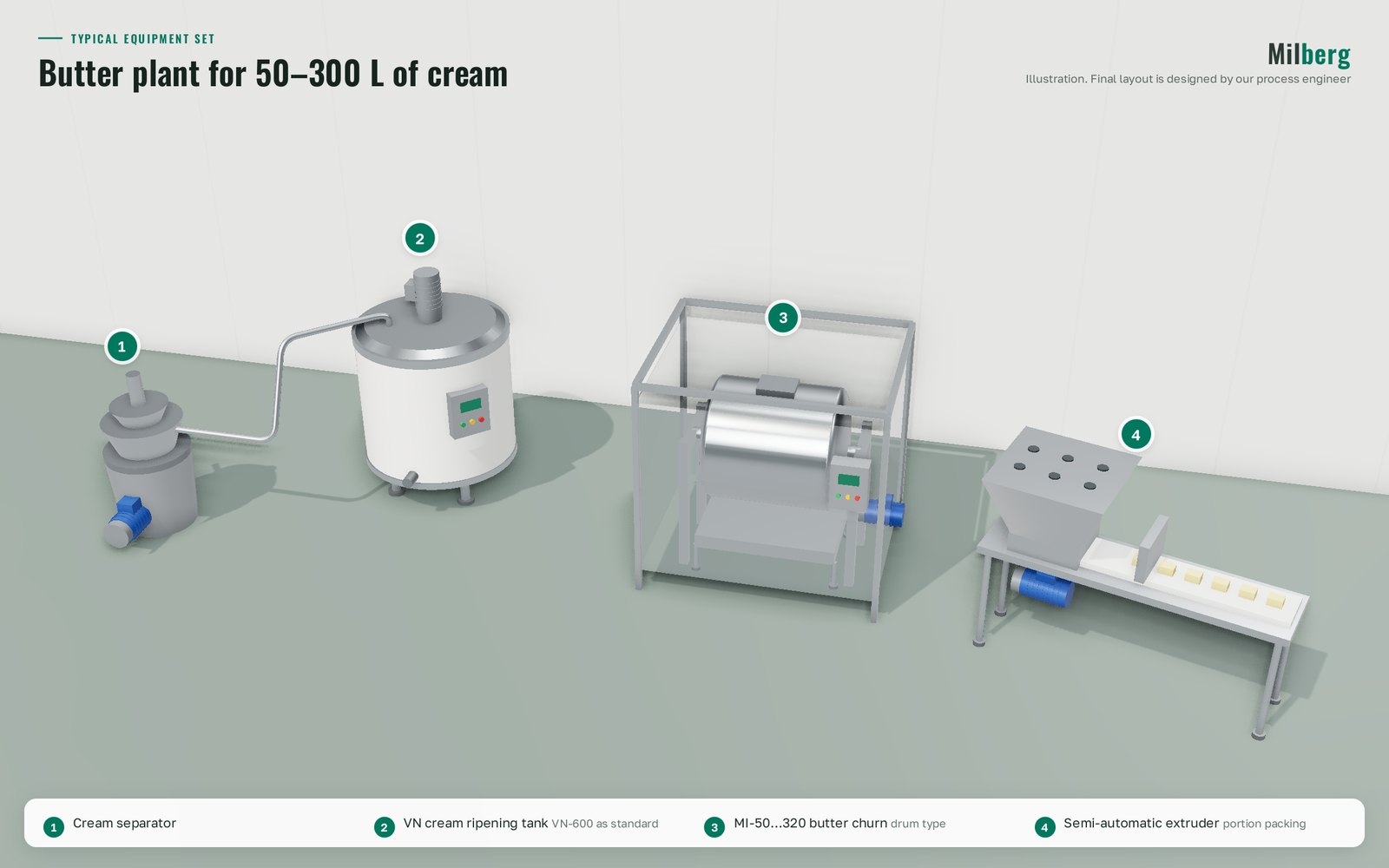 Butter workshop for 50–300 L of cream: butter production equipmentSeparator, cream ripening vat, butter churn, packing
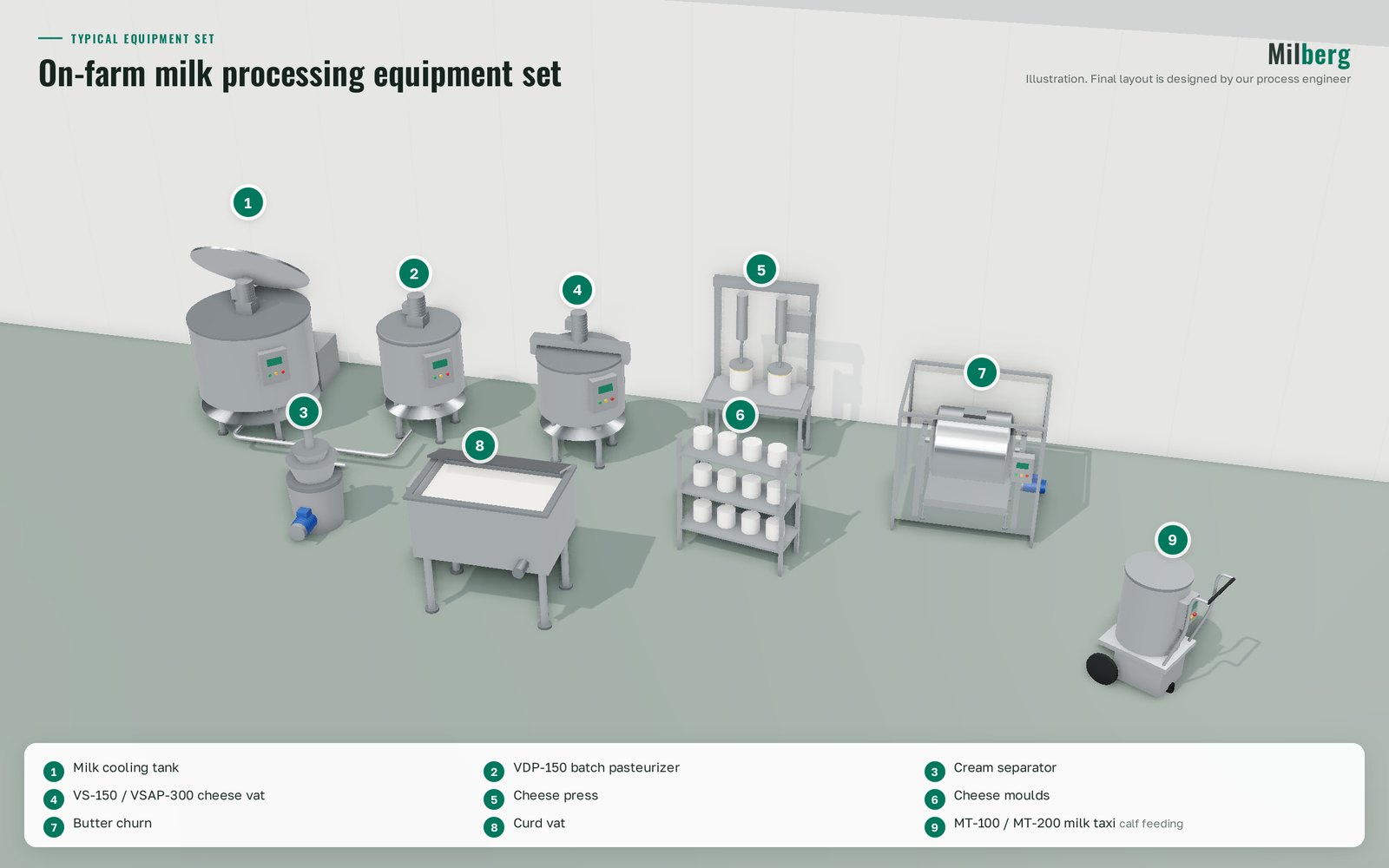 On-farm milk processing: equipment setCooling, pasteurization, cheese, butter and calf feeding — for the farm
Catalogue sections: Equipment sets, modular dairies and mini plants, Milk processing equipment, Butter making equipment