


Milk pump: which one does a dairy plant need?
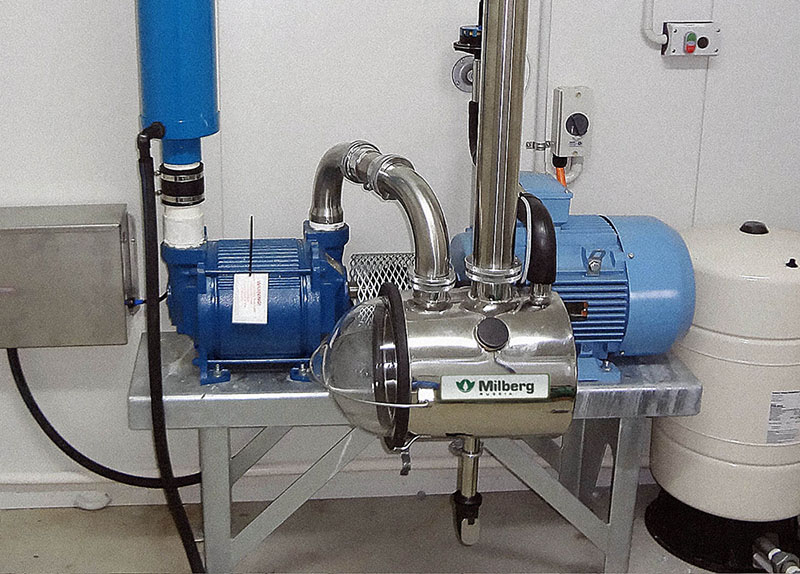
In short. A milk pump is selected according to the product. Liquid products — milk, skim milk, cream, buttermilk, whey — are transferred with a centrifugal pump: it is simple, compact and reliable. Viscous products — sour cream, kefir, yoghurt, ryazhenka — are handled by self-priming impeller or screw pumps. Next, the flow rate (how many cubic metres per hour) and the head (how high and against how much resistance the product must be pumped) are matched to the line. All product-contact parts are made of food-grade stainless steel.
Which pump for which product
| Product | Pump type | Why |
|---|---|---|
| Milk, skim milk, cream, buttermilk, whey | Centrifugal | Low-viscosity products that need a smooth, pulsation-free flow |
| Sour cream, kefir, yoghurt, ryazhenka | Self-priming impeller or screw pump | A centrifugal pump cannot cope with viscous products |
| Mixtures with particles (e.g. milk replacer slurry for calf feeding) | Flexible impeller pump | Suitable for dispensing a thick mixture through a gun |
The centrifugal pump is the workhorse of a dairy plant. But it has limitations: it is not self-priming, it does not like air in the product, and it cannot handle viscous media. Its pros and cons are covered in detail in the article "Centrifugal pumps". That is why a centrifugal pump is installed so that the product flows to it by gravity, and a different type of pump is used for cultured dairy products.
What the figures in ONTs 6.3/20 mean
Farms often specify a pump model straight away in their enquiries, for example: "ONTs 6.3/20 — 2 pcs, ONTs 12.5/20 — 1 pc, ONTs 25/30 — 1 pc, product — milk". (ONTs is the Russian designation for a centrifugal pump.) The first figure in such a designation is the flow rate in cubic metres per hour, the second is the head in metres. So the ONTs 6.3/20 pumps 6.3 m³ of milk per hour at a head of 20 m.
Besides ONTs pumps, we supply G2-OPA, G2-OPB, G2-OPD, ONTs1, ONTs-s, NTsS-12/10 and 2G2-OPD pumps, as well as equivalents of imported brands — Inoxpa, GEA Hilge, Packo, Jabsco, Bornemann. Steel grades: AISI 304, 316L or 321.
How to size flow and head
Flow rate must match the capacity of the equipment the pump feeds. When we supplied a PT-2000 continuous pasteurizer with a milk pump to a company in Kazakhstan, the pump was sized precisely for the pasteurizer's 2,000 L/h, so the pair works in sync, without air locks or flow surges (case study).
Head depends on where the product is going: how high it has to be lifted, how long the pipeline is, and how many heat exchangers, filters and valves are in the way. The longer and more complex the route, the more head you need.
The flow of a centrifugal pump can be regulated in two ways: with a frequency converter or with a manual valve on the discharge side. A valve is cheaper: the pump runs at full head and the flow is throttled by hand. A frequency converter is more convenient if operating modes change often.
Can butter be pumped?
A screw pump is suitable for sour cream and cultured dairy products: they can be pumped out almost completely, and losses after a shift and cleaning are minimal. Butter and spread are a different matter. They are viscous, almost plastic, and expensive, so the "unload into a hopper and pump to the packing machine with a screw pump" approach has not caught on in practice: product left in the pipes after a shift is a costly loss. Other solutions are used for butter — from auger feeding to a butter cutter.
Pumps built into other equipment
Often a separate pump is not needed because it is already part of a unit:
- in a milk reception and metering station the pump comes as a set with a meter, filter and heat exchanger; for small farms there is a cart with a pump of up to 8 m³/h, a filter and a meter;
- in the milk taxi milk is dispensed by a battery-powered electric pump with a dosing gun; on request, the pump delivers a dose set on the control panel.
The pumps are also suitable for cleaning: the internal cavity is polished, and the design allows CIP cleaning without disassembly.
What to include in a pump enquiry
To select the right pump first time, tell us:
- Which product you are pumping and its temperature.
- How much per hour — or which equipment the pump will feed.
- From where to where: lift height, pipeline length, what is in the way.
- Whether flow regulation is needed.
- If applicable, the model of the pump you want to replace.
Based on this information, we will select a milk pump and prepare a quotation within one working day. All equipment for dairy production is in the "Milk processing equipment" section.
Milberg equipment mentioned in this article
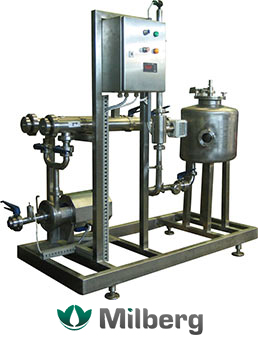 SPM milk reception and metering stationIn-line milk reception and metering
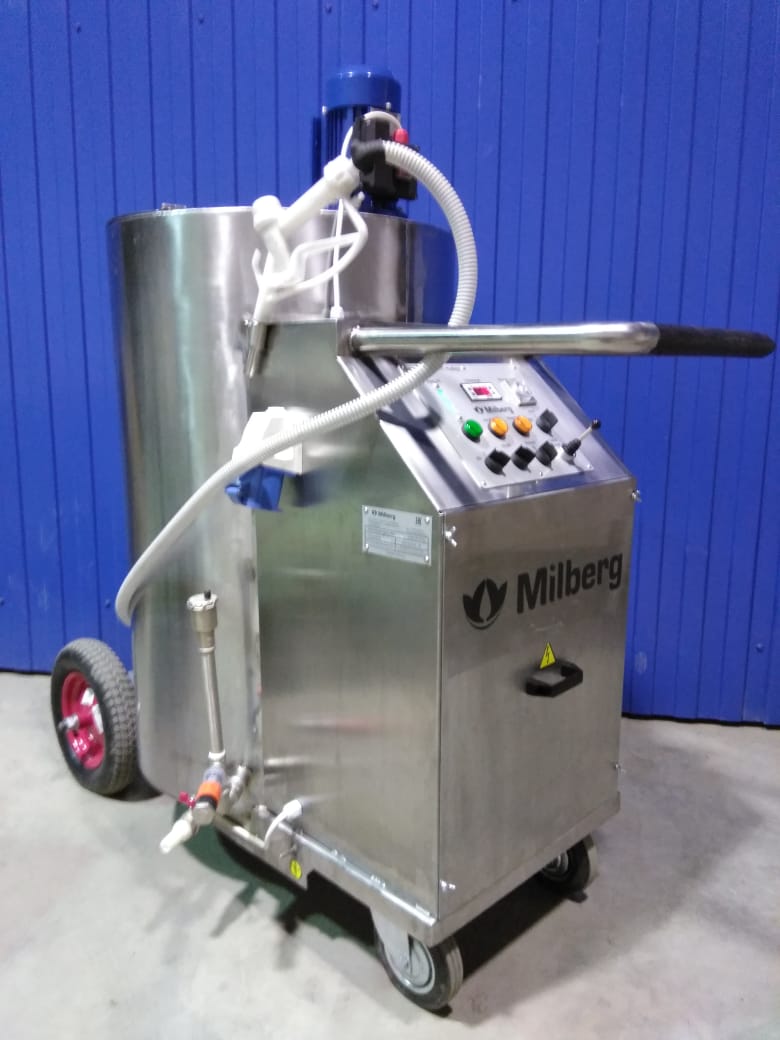 Milk taxi for calf feeding (milk shuttle)Calf feeding, pasteurization, milk replacer
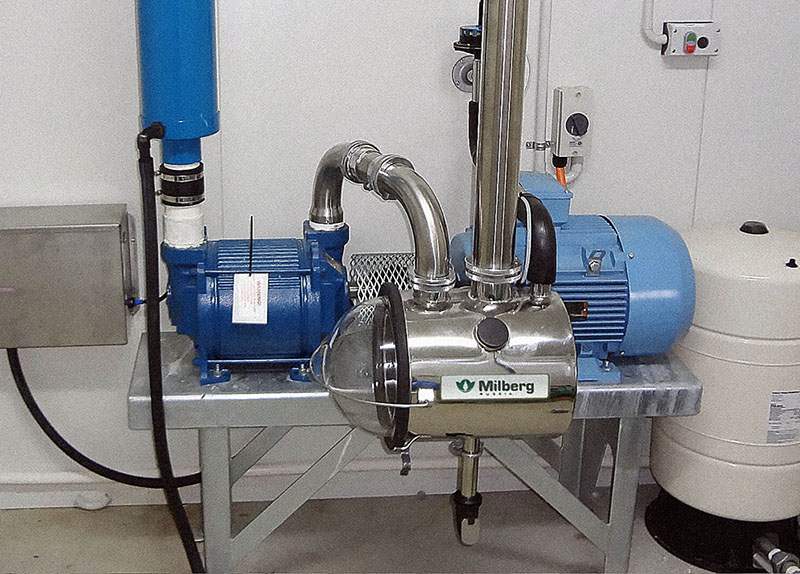 Milk pumps for the dairy industry — G2-OPA, G2-OPB, G2-OPD, ONTs, ONTs1, ONTsS, NTsS-12/10, 2G2-OPDTransfer of milk, cream, whey and cultured dairy products
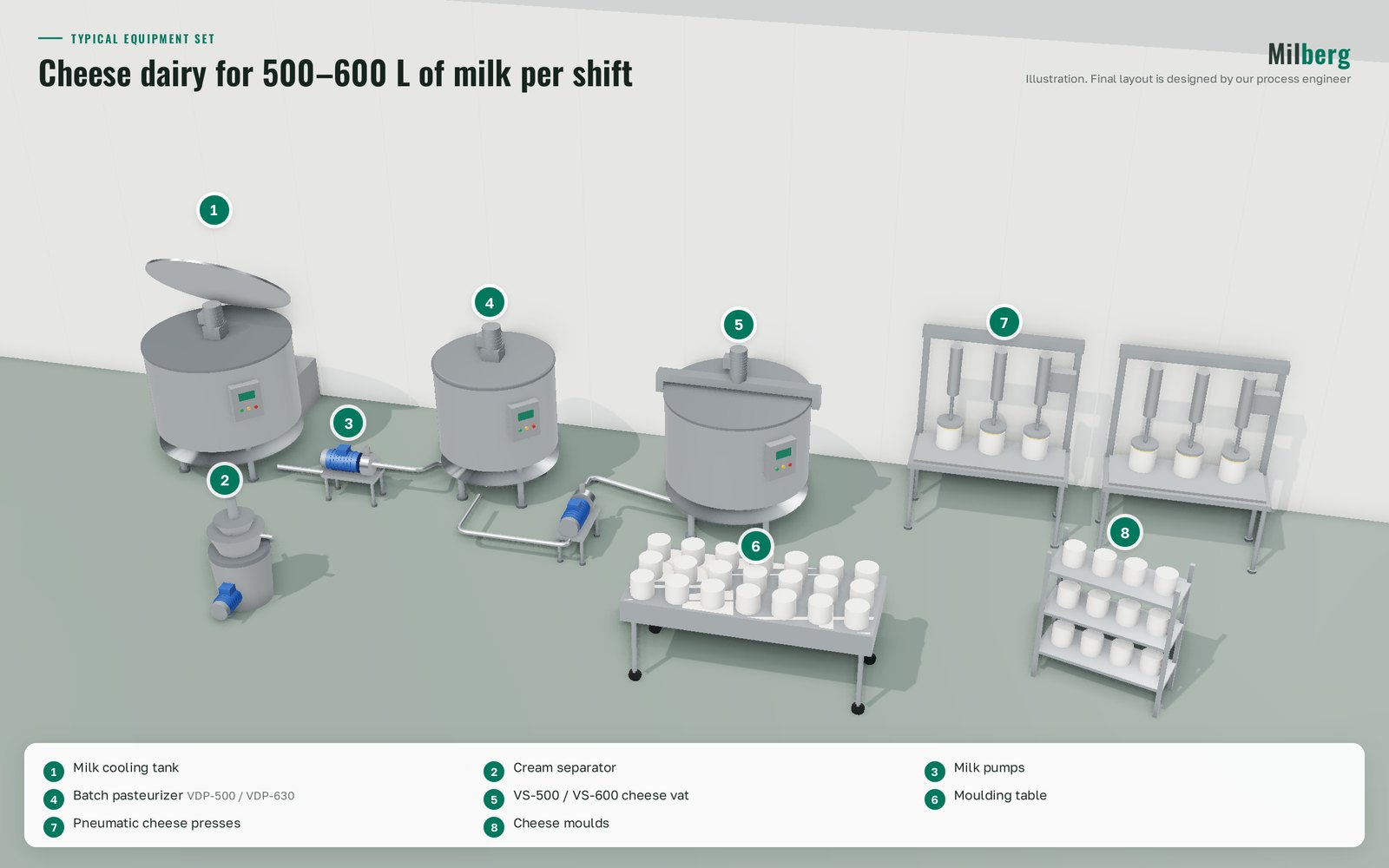 Cheese workshop for 500–600 L of milk500–600 L cheese vat, pasteurization, pumps, pressing
Catalogue sections: Milk processing equipment, Equipment sets, modular dairies and mini plants