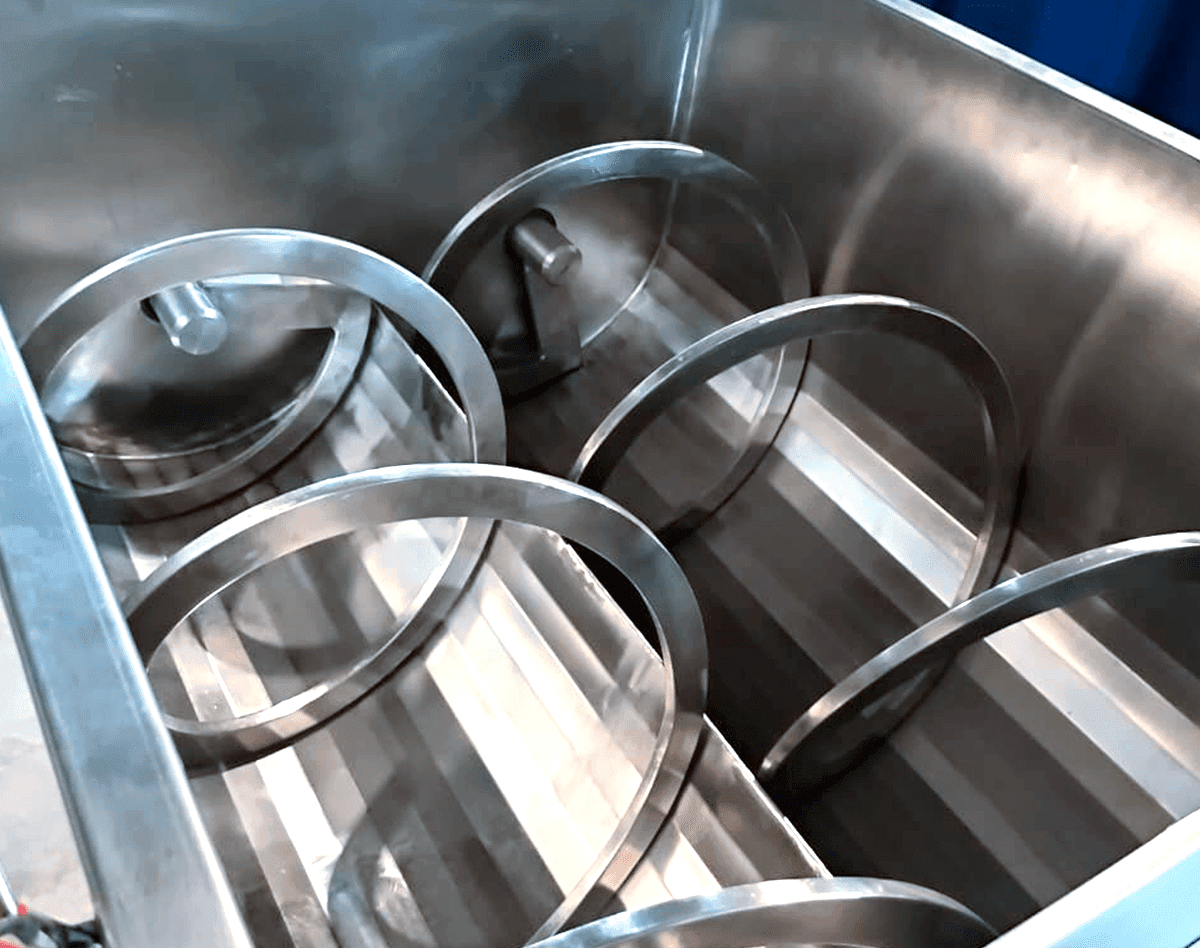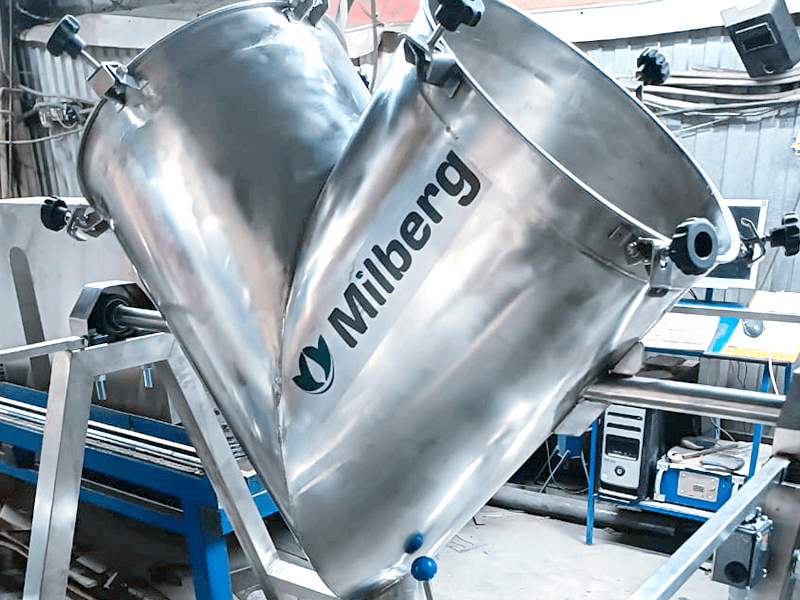


Drum flaker (cooling drum crystallizer)
Cooling melts into flakes — fats, waxes, chocolate, soap, chemicals
⏱ Calculation and quotation within one business day
CE marking · ISO 9001 · export deliveries, commissioning. Terms →
Description
A drum flaker (drum crystallizer, cooling drum, drum cooler, roller crystallizer) is equipment for rapidly cooling a molten product and obtaining it in solid form as flakes. The melt is applied in a thin layer onto a rotating drum with coolant circulating inside; it solidifies within one revolution and is removed by a knife or scraper. The output is free-flowing flakes that are easy to dose, bag, store and dissolve.
Flakers are used to cool and flake products of the food, feed, cosmetics and chemical industries: confectionery and vegetable fats (palm stearin, hydrogenated fats, cocoa butter substitutes), chocolate, compound coating and chocolate chips, milk fat; feed fats and protected (bypass) fats for dairy cows; soap base and soap chips; waxes (beeswax, paraffin, polyethylene wax), stearin, fatty acids and alcohols, surfactants; sulphur, resins and rosin, alkalis (caustic soda flakes) and other products that melt and solidify.
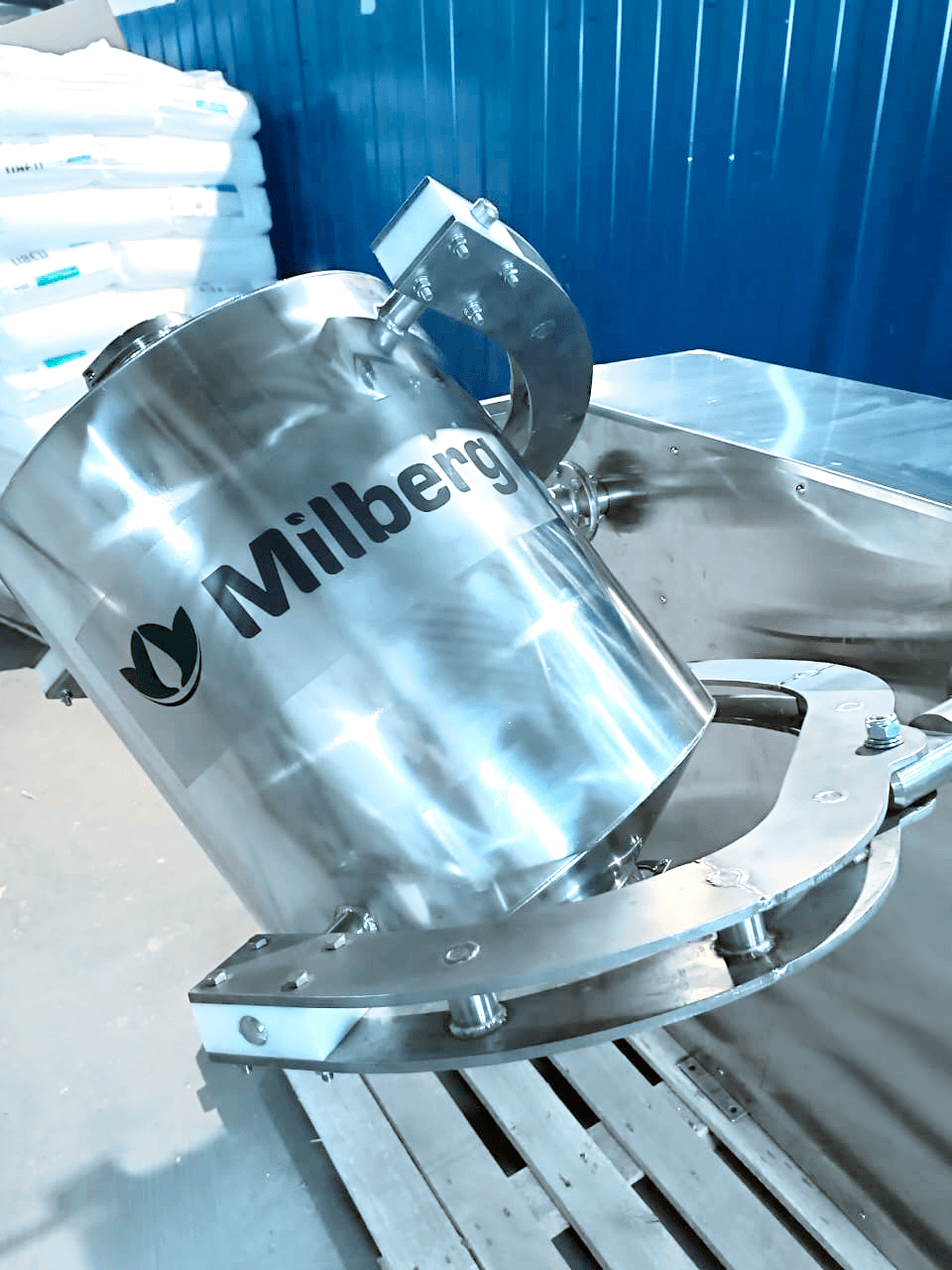
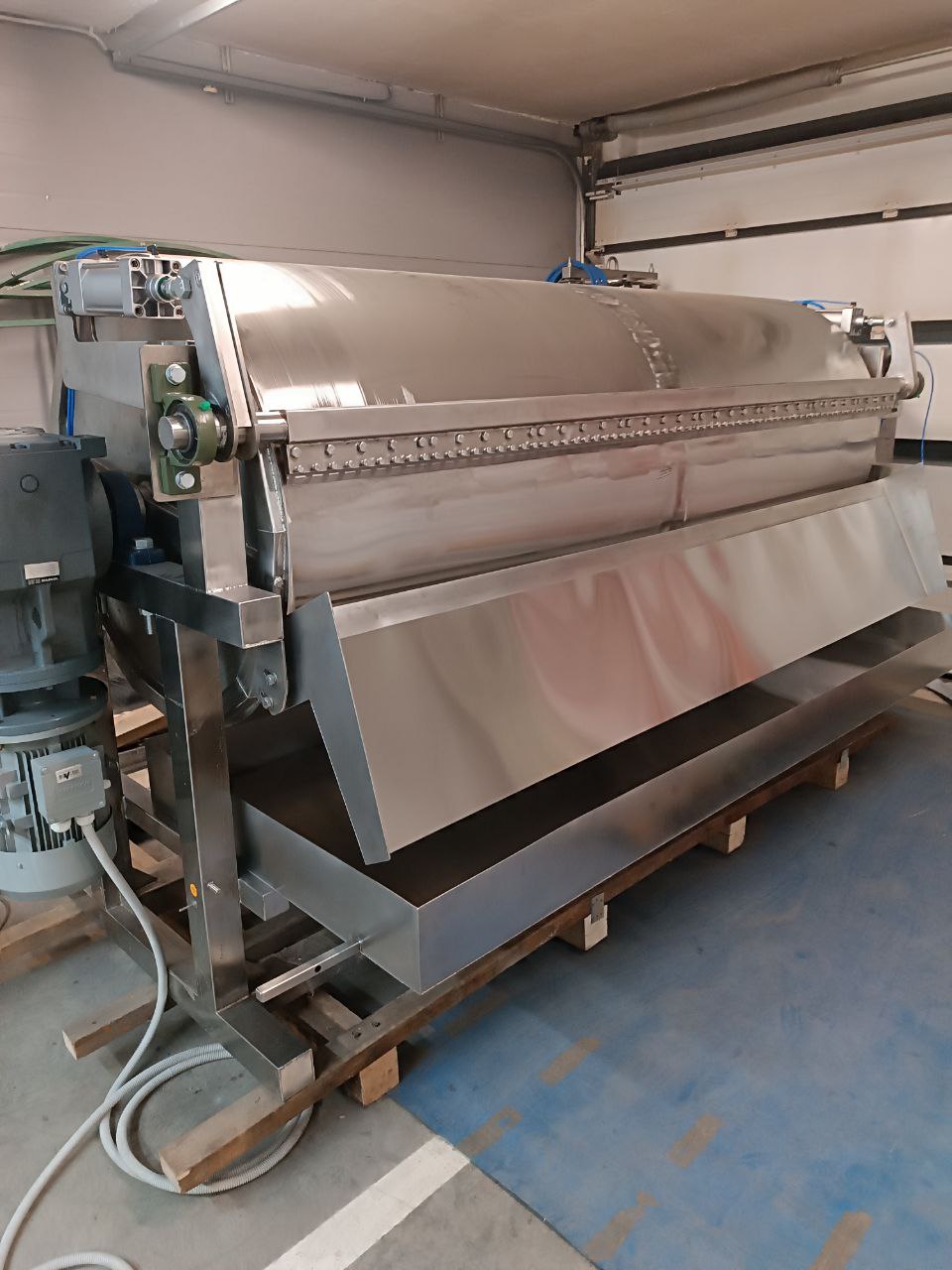
Design of the Milberg flaker: a stainless steel drum on bearing supports, driven by a geared motor, with a feed trough for the melt under the drum. The take-off knife is pressed against the drum by pneumatic cylinders; the pressing force is adjustable and monitored on a pressure gauge, and the knife is raised and lowered by a lever on the control panel, so take-off can be set precisely for the layer thickness and product. Frame and covers are stainless steel.
The key parameter of a flaker is the cooling surface area of the drum, determined by its diameter and length. Sizes range from a compact 300 mm drum (about 0.4 m², internal volume about 30 L) for pilot and small-scale production up to a 1500 mm drum (about 8 m², volume up to 3,000 L) — see the specifications table. The product application method is chosen according to viscosity and adhesion: dipping the drum into a trough for liquid melts that adhere well to metal; a bottom roller for medium-viscosity products; top applicator rollers for viscous and poorly adhering products. For odorous and toxic products, a closed hood with extraction is used. Application and take-off diagrams are shown in the photo gallery.
The drum configuration is selected and calculated individually for each product and task: drum size, product application method (feed trough, applicator roller, top distributor), knives or scrapers for take-off, coolant, variable-speed drive, hood, extraction and flake discharge (chute, screw, conveyor). We make drums from 300 to 1500 mm in diameter.
If you have a hot melt that needs to be cooled quickly and turned into free-flowing flakes, send us the product, melt temperature and required capacity: our engineer will select the drum size and configuration and prepare a quotation.
Advantages
- Rapid cooling of the melt within one drum revolution, so the product has no time to separate
- Free-flowing flakes instead of a solid block: easy to dose, pack, store and dissolve
- Fats, waxes, chocolate, soap, chemicals — configuration to suit your product
- Take-off by knife or scrapers; layer thickness and drum speed set for the product
- Drums Ø300–1500 mm (0.4–8 m²), product-contact parts in AISI 304/316
- Calculation and selection of the configuration for your task, manufactured at our plant in Yekaterinburg
Specifications
| Model | FBK 3/4 / 4/6 / 5/8 / 6/10 / 8/12 / 10/15 / 12/20 / 15/17 |
| Cooling area, m² | 0.4 / 0.8 / 1.3 / 1.9 / 3.0 / 4.7 / 7.5 / 8.0 |
| Drum diameter, mm | 300 / 400 / 500 / 600 / 800 / 1000 / 1200 / 1500 |
| Drum length, mm | 400 / 600 / 800 / 1000 / 1200 / 1500 / 2000 / 1700 |
| Internal drum volume, L (for reference) | 28 / 75 / 157 / 283 / 603 / 1178 / 2262 / 3004 |
| Purpose | cooling melts and obtaining the product as flakes |
| Coolant | ice water, water-glycol mixture, brine — to suit the product |
| Product contact time with the drum | from a few seconds to a few minutes, set by the drum speed |
| Product application | dipping into a trough, bottom roller, top rollers, top distributor with press-on roller, double drum with feed into the gap — to suit the product |
| Product take-off | knife or scrapers; pneumatic knife pressing with force adjustment by pressure gauge |
| Drive | geared motor |
| Material | AISI 304 / AISI 316 — to suit the product |
| Options | closed hood with extraction, flake discharge screw or conveyor, variable-frequency speed control |
| Configuration | selected and calculated individually for the product and task |
FAQ
What is a flaker?
A flaker is the same as a drum crystallizer or cooling drum. The melt is applied in a thin layer onto a rotating cooled drum, solidifies within one revolution and is removed by a knife as flakes.
Which products is a drum crystallizer suitable for?
For products that melt and solidify, such as confectionery and vegetable fats, chocolate and compound coating, feed and protected fats, soap base, waxes and paraffin, stearin, fatty acids, sulphur, resins and alkalis. We select the configuration for the specific product.
What drum sizes are available?
The key parameter is the cooling area, from 0.4 m² (Ø300 mm drum, volume about 30 L) to 8 m² (Ø1500 mm, volume up to 3,000 L). Standard sizes are in the specifications table; non-standard sizes are calculated for the task.
Which drum should I choose?
We size the drum based on the required capacity, which depends on drum area, melt temperature, layer thickness and coolant. Send us the product and the required amount per hour, and we will make a selection.
How is flake take-off adjusted?
The knife is pressed against the drum by pneumatic cylinders, the pressing force is set using a pressure gauge, and the knife is raised and lowered by a lever. Flake size and thickness are set by drum speed, layer thickness and knife position.
What removes the product from the drum?
Knives or scrapers, chosen according to the product and the required flake shape.
How is the configuration selected?
Send us the product, melt temperature and required capacity. Our engineer will calculate the drum size, application method, take-off, coolant and discharge, and prepare a quotation.
Is there a drum for drying rather than cooling?
Yes, the drum dryer. The drum is heated from inside and dries liquid and paste-like products into flakes. It has a separate page in the catalogue.
What product application schemes are there?
Dipping the drum into a trough, a bottom applicator roller, top applicator rollers, a top distributor with a press-on roller, and a double-drum scheme with feed into the gap. The diagrams are in the gallery; we choose according to the viscosity and adhesion of the product.