


Mixer for powders and bulk products: Drunken barrel, V-blender, ribbon or paddle — which to choose
In brief. Mixers for bulk products fall into two groups. In the "Drunken barrel" (tumble) mixer and the V-blender, the whole vessel rotates and the product is mixed by tumbling — a gentle method for free-flowing powders and granules. In ribbon and paddle mixers the vessel is stationary and the product is moved by an agitator — this is how caking, poorly flowing blends and blends with liquid additions are mixed. The Milberg plant makes all four types in volumes from 30 to 3,000 L, including a pharmaceutical-grade version.
Where do you start when choosing a mixer?
Not with volume or price, but with the product. Before proposing a mixer, we ask three questions:
- How does the product behave — does it flow freely, or does it cake and form lumps?
- Does the recipe contain minor additions (premixes, vitamins, spices) or liquid?
- How many kilograms go into one batch, and how often does the recipe change?
The first answer determines the mixer type, the second the design version, and the third the drum volume and how important complete discharge and quick cleaning are.
How does the Drunken barrel differ from a V-blender?
Neither mixer has an agitator inside: the product tumbles inside a rotating vessel, so granules are not broken and the blend is not ground down.
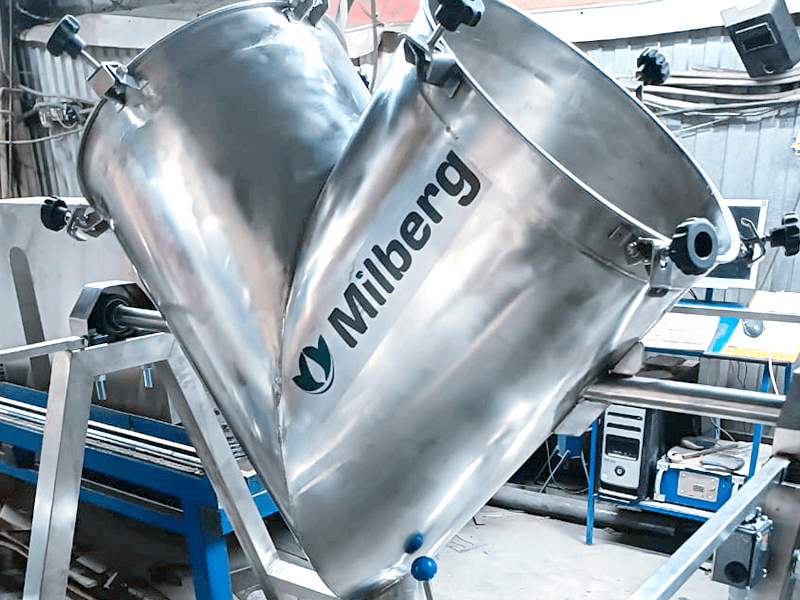
In a V-blender, the vessel consists of two connected cylinders forming the letter V. With each revolution, the product splits into two streams and then recombines. Standard volumes are 100, 150, 200, 300 and 500 L; on request — from 30 to 3,000 L. It is used for dry milk mixes, milk replacer, premixes, spices and compound feed; granules can also be mixed with liquids in it.
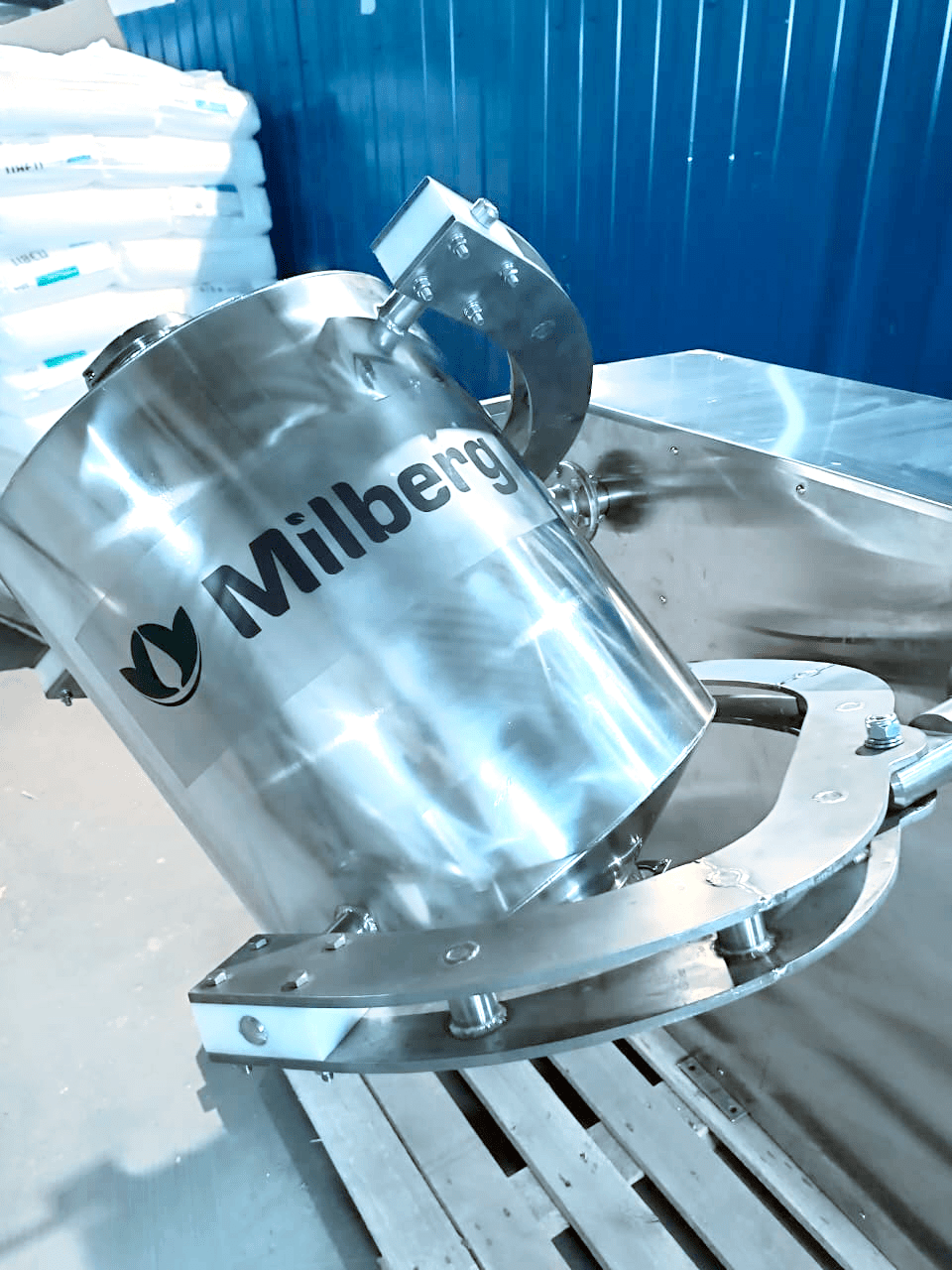
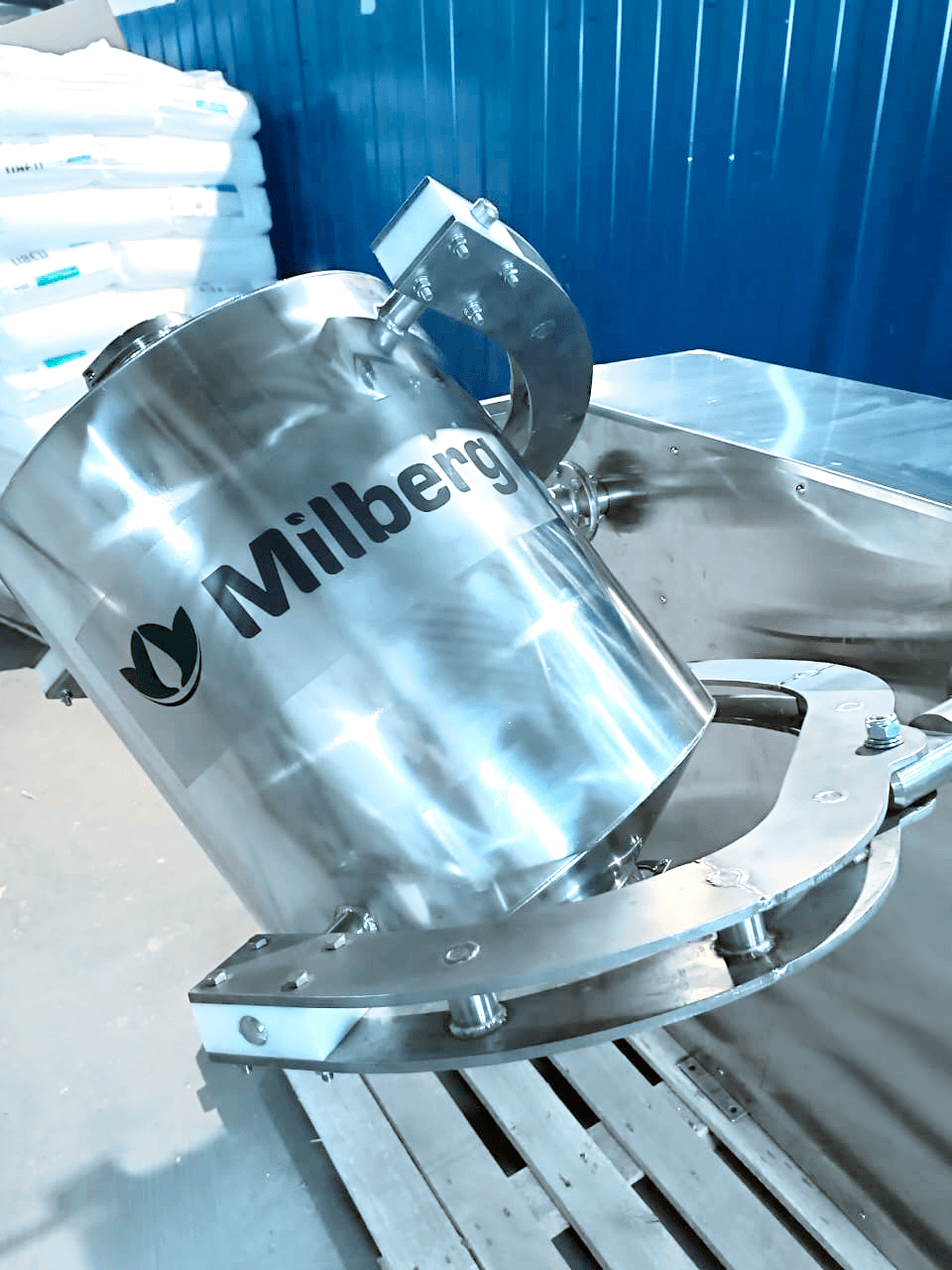
In the "Drunken barrel", the drum performs a spatial, multidirectional motion with no dead zones. The blend does not segregate into fractions, homogeneity can exceed 99.9%, and the finished blend is discharged by gravity with no residue. It comes in a classic (2D) version and a 3D version for particularly homogeneous blends and minor additions such as premixes.
In practice, the main difference is how much product can be loaded at a time.
"A conventional V-blender or Drunken barrel is loaded to 40–60% of the drum volume per batch. A 3D barrel can be loaded up to 90%, and blend homogeneity reaches 99.9%. That is why a smaller 3D barrel sometimes replaces a conventional mixer one size up." — Alexey Troshin, Director of the Milberg plant
When do you need a ribbon or paddle mixer?
If the product cakes, flows poorly, has particles of very different sizes, or the recipe includes liquid, tumbling in a drum may not be enough. In that case you choose a mixer where the vessel stays still and an agitator does the work.
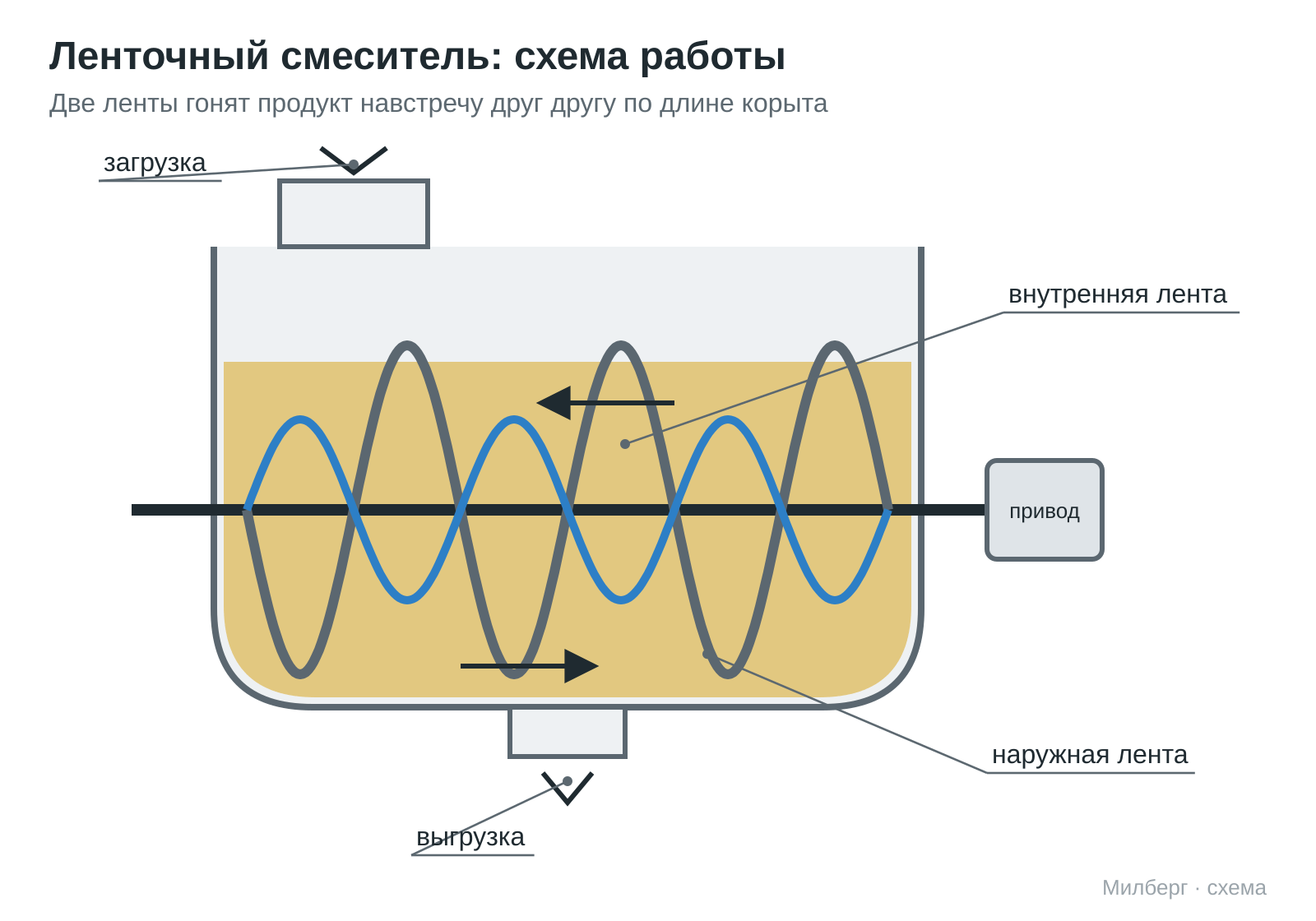
A ribbon mixer is a horizontal trough with a shaft carrying two helical ribbons: the outer ribbon drives the product towards one end, the inner one towards the other. The opposing flows mix the entire volume over and over. Loading is through a hatch on top, discharge through a bottom gate.
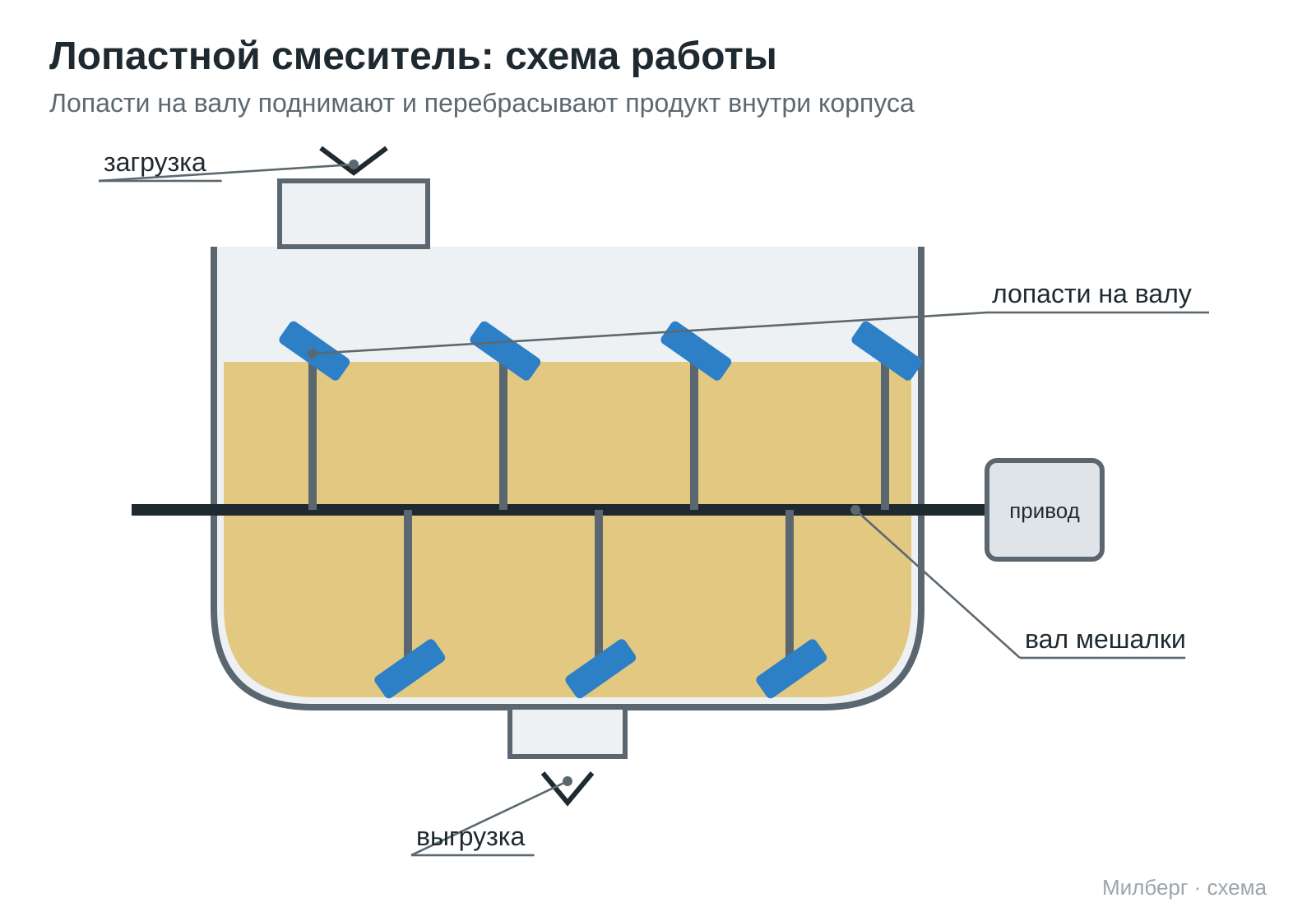
A paddle mixer mixes the product with paddles on a shaft that lift and throw the mass. It is chosen for blends of particles of different sizes and with liquid additions; we design the agitator for the product and batch size.
Ribbon or paddle — we decide based on the product, batch size and homogeneity requirements. We make both in stainless steel, from 30 to 3,000 L.
Four types of mixers compared
| Type | What moves | Suitable products | Key strength |
|---|---|---|---|
| Drunken barrel 2D / 3D | The whole drum, in three dimensions | Free-flowing powders and granules, premixes, minor additions | Homogeneity can exceed 99.9%; 3D version loads up to 90% of volume; discharge with no residue |
| V-blender | The whole two-cylinder body | Dry milk mixes, milk replacer, premixes, spices, compound feed; granules with liquids | No agitators inside — a smooth vessel, convenient for frequent recipe changes |
| Ribbon | Two helical ribbons in a stationary trough | Dry blends and powders, poorly flowing products, a small proportion of liquid | Mixes what cannot be mixed by tumbling |
| Paddle | Paddles on a shaft in a stationary body | Dry blends, particles of different sizes, liquid additions | Agitator designed for the product |
What mixer volume do you need for your batch?
A common mistake is to choose the volume by product weight. The drum is not filled to the top, and the powder may be light, so the calculation should go: batch weight → how many litres it occupies → what share of the drum is loaded.
Example: 100 kg of powder with a bulk density of 0.5 kg/L occupies about 200 L. If the mixer is loaded to half its volume, you need a drum of about 400 L. If it can be loaded up to 90%, as with a 3D barrel, a drum of about 230 L is enough. Sugar, milk powder, spices and premixes all have different bulk densities — which is why we always ask exactly what you are mixing and how many kilograms go into one batch.
What else to consider: discharge, cleaning, options
- Recipe changes. The Drunken barrel and V-blender have no agitators inside; the vessel discharges completely and is easy to clean between batches. This reduces the risk of carrying traces of one recipe over into another.
- Discharge. Drunken barrel — by gravity, with no residue; V-blender — through a bottom hatch; ribbon mixer — through a bottom gate.
- Options. The final specification depends on speed control, a panel with programs for automatic modes, automatic shut-off and stainless steel guards. The V-blender comes as standard with a start/stop unit and a motor interlock system for operator safety.
- Pharmaceuticals. A separate version is available for pharmaceutical production — requirements for steel, surfaces and documentation are discussed when preparing the quotation.
Where Milberg mixers are already in operation
- Dairy plant, Moscow. An SPB-100 Drunken barrel together with a unit for reconstituting dry concentrates — for precise multi-component blends. The plant has signed two contracts with us, in 2024 and 2025 (more details).
- Cheese and curd products manufacturer, Novosibirsk Region, 2026. An SPB-50 Drunken barrel blends in spices, herbs and paprika without breaking down the structure of the mass.
- Butter paste manufacturer, Moscow, 2025. The Drunken barrel solved the problem of uneven distribution of fillers, which had been sending some batches back for reprocessing.
- Food manufacturer, Moscow, 2024. A V-blender in the dry-blend preparation area — with no cross-contamination between recipes (more details).
- Dry-blend manufacturer, Novosibirsk Region, 2024. A V-blender for dry dairy products and multi-component blends.
All projects are in the ["Case studies"](/projects/ section.
Tell us what you are mixing, how many kilograms go into one batch and how often you change the recipe — we will select the mixer type and volume and send a quotation within one business day. All models are in the "Mixers for bulk products" section.
Milberg equipment mentioned in this article
 V-blenderDry mixing of powders, granules, milk replacer and premixes
 "Drunken barrel" tumble mixer (classic and 3D)Mixing of dry powders and granular materials
 Ribbon blenderHorizontal mixer for bulk products and dry blends
 Paddle mixerMixer with paddle agitator for bulk products and dry blends
Catalogue sections: Mixers for dry bulk products, Other food equipment