


Why do you need a milk cooler?
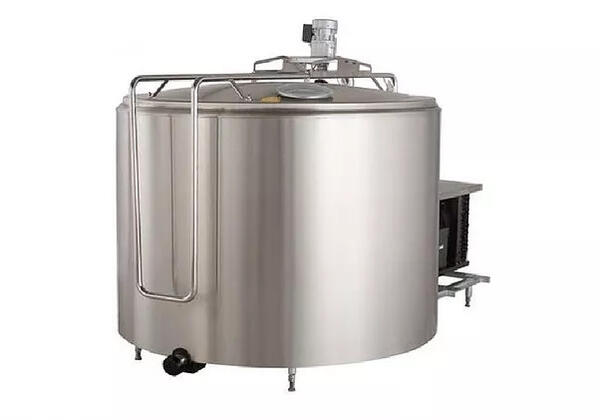
In brief. A cooler brings freshly drawn milk down from 36 °C to +4 °C to stop bacteria from multiplying: uncooled milk has to go into processing within 20 hours. Coolers can be open (a vat with a lid — for small volumes, washed by hand) or closed (a tank — for larger volumes, with automatic cleaning). Cooling is provided by an ice bank, refrigerant or ice water; it takes about three hours on average.
It is no secret that dairy products are healthy and tasty and contain plenty of vitamins and minerals. Milk, the basis of all these products, must be fresh when processed. Unfortunately, it has one drawback: it spoils very quickly. Fresh milk straight after milking has to be used within 20 hours, otherwise it becomes a breeding ground for bacteria, microbes and infections that are quite dangerous to humans. In practice, it is not always possible to start processing in time. Milk coolers were invented so that milk can be kept longer (while retaining its vitamins). First, let us answer the question: what exactly is a milk cooler?
It is special equipment that lowers the temperature of the product to a level at which bacterial growth is kept to a minimum. Fresh milk after milking is about 36 °C. To stop spoilage, it is cooled to +4 °C. Doing this naturally is quite difficult — the climate does not always allow it. So the milk is placed in special milk cooling tanks. Modern farms cannot imagine working without this equipment.
Types of coolers and how they work
First you need to choose the type of cooler. They can be horizontal or vertical, open or closed. Let us look at them in more detail.
An open milk cooler is a vat with a lid. Such units are mainly designed for small volumes of milk and are cheaper both to buy and to maintain. They do have a small drawback, though: they are washed by hand, so you need to be particularly careful when cleaning to make sure no traces of milk or detergent remain on the walls.
A closed milk cooler is a kind of "tank". It is usually cylindrical, elliptical or oval in shape and horizontal. Compared with the first type, a milk tank is designed for larger volumes and is often used at dairy plants and factories; it is cleaned automatically, which makes it the most convenient type. The lid stays closed during operation, so air, dust and microbes cannot get into the product.
All coolers have one purpose — to lower the temperature of the milk. This can be done with a dedicated ice bank, with refrigerant, or with ice water (the principle here is quite simple: water flows through pipes to the walls of the tank, cools the milk and then drains into a special generator). Refrigerant works in a similar way: it reaches the walls and lowers the temperature of the milk. On average, cooling takes about three hours.
To buy a vertical or horizontal milk cooler, send a request through our website. Various models are available, depending on the scale and purpose of use. You can also buy a milk cooling vat.
Milberg equipment mentioned in this article
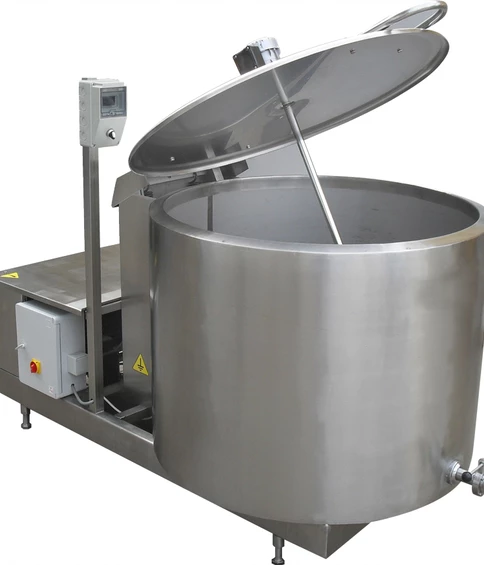 Milk cooler (milk cooling tank)Rapid cooling of milk after milking and pasteurization
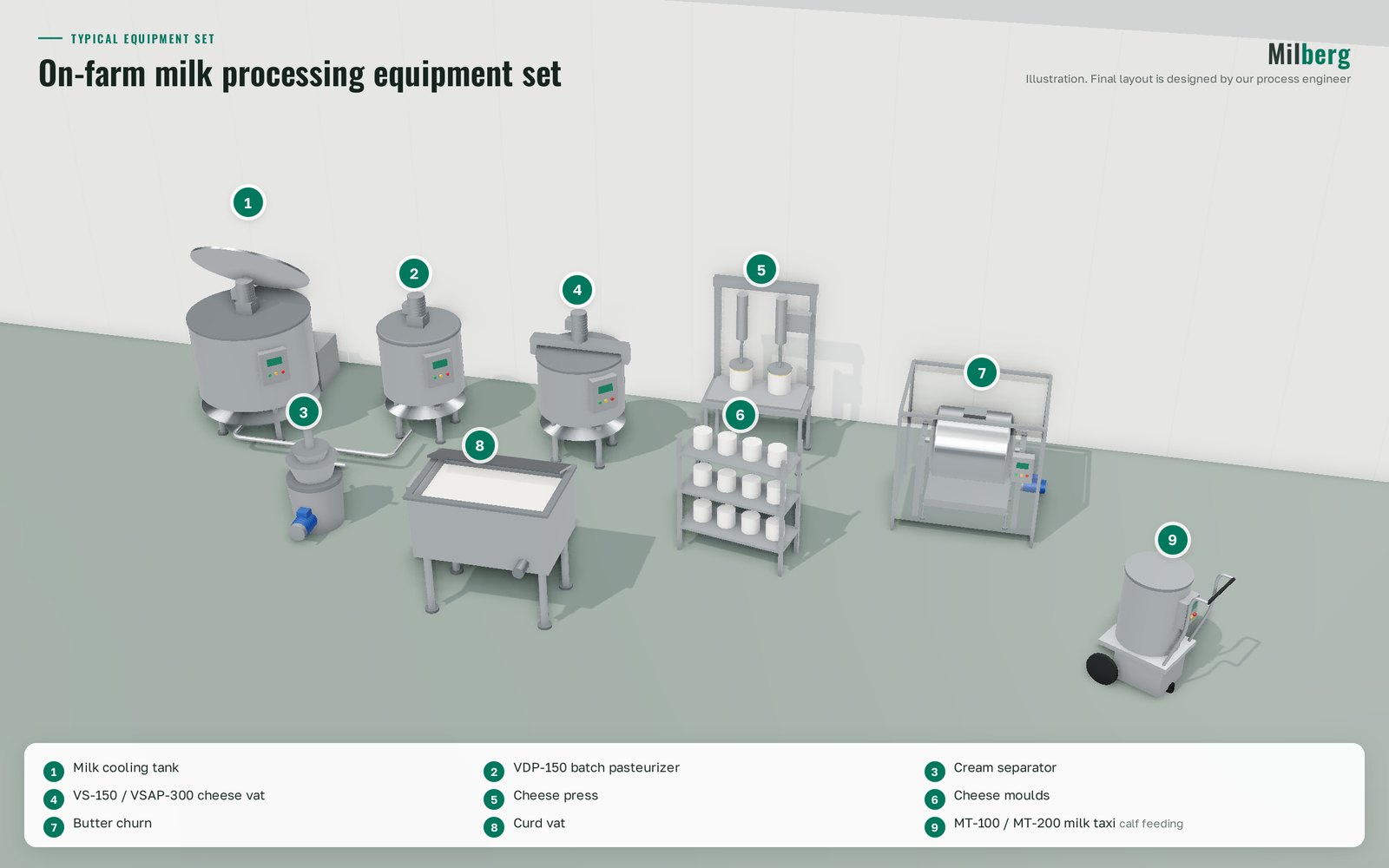 On-farm milk processing: equipment setCooling, pasteurization, cheese, butter and calf feeding — for the farm
Catalogue sections: Milk processing equipment, Equipment sets, modular dairies and mini plants